


Small Farm Aggregation at Scale: Farmer Producer Organizations in India and Beyond
Abstract
Over the past decade, farmer producer organizations (FPOs) have become central to India’s agricultural policy, with the government positioning them as an important institutional mechanism for enabling smallholders to access better markets, credit and agricultural inputs. Successive national initiatives have supported the formation of thousands of these collectives. However, their performance has been mixed. Many FPOs continue to face challenges in achieving financial sustainability, maintaining member participation and establishing effective governance structures, particularly after external institutional and financial support comes to an end. Against this backdrop, this seminar examines what the available evidence tells us about whether and how FPOs work, and for whom.
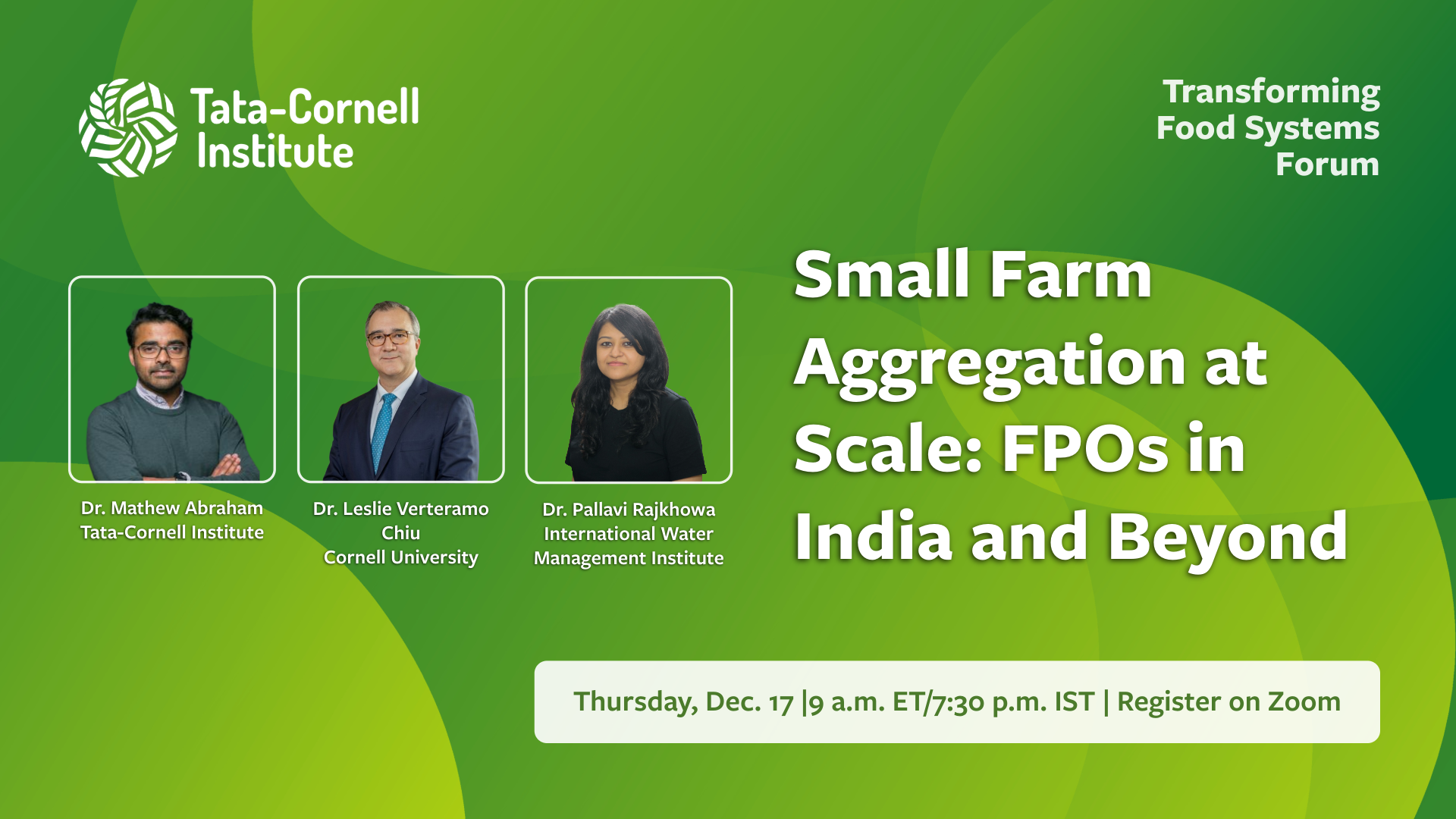
Mathew Abraham opens the discussion with an overview of the current landscape of farmer producer companies (FPCs) in India. Drawing on recent national data on FPC financials from the Ministry of Corporate Affairs (MCA), he assesses their business viability, governance arrangements, and member engagement, highlighting key challenges and emerging opportunities. He also discusses the implications of these findings for policymakers and organizations involved in promoting and supporting FPCs.
Pallavi Rajkhowa brings an empirical perspective to the discussion by examining the relationship between geographical location, market access, and the financial performance of FPCs in India. Her analysis investigates how proximity to markets and access to economic opportunities shape FPC profitability, highlighting the role of spatial and institutional factors in determining business viability. She also brings a gender lens to the discussion, exploring the representation and performance of women-led and women-majority FPCs and examining how gender intersects with market access, organizational characteristics and profitability. The findings shed light on the structural constraints faced by different types of FPCs and the policy and institutional measures needed to strengthen their financial sustainability and inclusiveness.
Leslie Verteramo Chiu broadens the discussion through a comparative perspective from Latin America, where producer associations, cooperatives and other forms of collective aggregation have a longer and more diverse history. His contribution highlights lessons from the experiences of both regions, drawing attention to transferable successes as well as common institutional and operational challenges.
The presentations explore the institutional arrangements, organizational choices and policy support needed to strengthen producer collectives and enhance smallholder livelihoods.
The seminar concludes with a moderated question-and-answer session.
Speakers
Dr. Mathew Abraham
Dr. Mathew Abraham is the assistant director of TCI. He coordinates research and provides strategic guidance and support for project implementation. Previously, Mathew joined TCI as a postdoctoral associate in August 2015, after completing his PhD from the Department of International Economics and Management at the Copenhagen Business School in Denmark. Prior to that, he worked at the Centre for Public Policy at the Indian Institute of Management Bangalore. He has a master’s degree from Lund University in Sweden and a bachelor’s degree from St. Stephens College in Delhi. His research focuses on evaluation methodologies, agricultural value chains and markets, food security in developing countries, and technology and institutional innovation for agricultural development.
Dr. Pallavi Rajkhowa
Dr. Pallavi Rajkhowa is a regional researcher at the International Water Research Institute (IWMI) and an agricultural economist with over 14 years of experience advancing sustainable food systems and rural development. She has published widely in leading international peer-reviewed journals, including Food Policy, Food Security, Social Science & Medicine and the Journal of Agricultural Economics, among others, and brings extensive expertise in policy advocacy and program management. Before joining IWMI, Rajkhowa worked as an Associate Research Fellow at the Tata-Cornell Institute at Cornell University and the Center for Development Research at the University of Bonn. Earlier in her career, she worked as a junior researcher with the International Food Policy Research Institute, the Indian Council for Research on International Economic Relations and the Confederation of Indian Industry.
Dr. Leslie Verteramo Chiu
Dr. Leslie Verteramo Chiu is a research economist at TCI and a visiting lecturer at the SC Johnson College of Business at Cornell University. His research area includes risk management for smallholder farmers, food-value chains, and agricultural finance, all under the context of developing countries. At TCI, he analyzes the effects of interventions on farmer producer organizations in Mexico. He received a PhD in applied economics from Cornell University, master’s degree in quality and productivity from the Instituto Tecnológico y de Estudios Superiores de Monterrey in Mexico, and a bachelor’s degree in business and economics from Sophia University in Japan.
Registration
Date & Time
Thursday, December 17 at 9 a.m. EST/7:30 p.m. IST