Study Shows Impact of India’s Ag Extension Call Centers
Every day, India’s Kisan Call Centers field thousands of calls from farmers seeking information or advice from agricultural extension agents. Do all those calls add up to improved outcomes on the farm? New research from an alumnus of the Tata-Cornell Institute for Agriculture and Nutrition (TCI) shows that the provision of digital extension services is linked to changes in crop yields.
In a study published in the journal Agricultural Economics, Chanchal Pramanik demonstrates the potential benefits of Kisan Call Centers, as well as their limitations. According to the study, an increase in calls related to weather was tied to an increase in paddy yields, while increased pest attacks in paddy fields (as measured by pest-related queries), corresponded with a drop in yields, suggesting that targeted enhancements, such as localized weather forecasts and region-specific pest alerts, could augment the impact of the call centers.
“These differential impacts highlight the need to align advisory content with both the timing and the nature of farmers’ information needs in developing countries,” Pramanik said.
As part of the study, Pramanik analyzed more than 17 million queries to Kisan Call Centers in ten states over a period of ten years. He also used data on weather and crop yields, in addition to various characteristics of farm households.
Weather and pests were the most frequent concerns of farmers who called the Kisan Call Centers. Pramanik found that a 1% increase in queries related to weather was associated with a 0.3% increase in average paddy yields. That sounds modest, but when scaled across large areas of farmland, even small improvements in yield can translate into substantial increases in production and income. According to Pramanik, the link between weather queries and yield suggests that weather forecasts can enhance farmers’ preparedness and decision-making.
With regard to pest-related queries, Pramanik found that a 1% increase in calls was tied to a 1.1% decrease in paddy yields. This is likely because such calls were made only after pests had begun to damage crops.
The expansion of mobile phone networks in rural parts of India and other developing countries has enabled the expansion of digital extension services for farmers, which provide information and advice on topics like weather, input utilization, pest management and market price fluctuations. India launched the Kisan Call Center program in 2004 to provide farmers with support in regional languages. At the call centers, extension agents with formal training in agricultural sciences respond to context-specific farming queries and offer tailored guidance. There are 21 call centers in total, with at least one in each state and union territory.
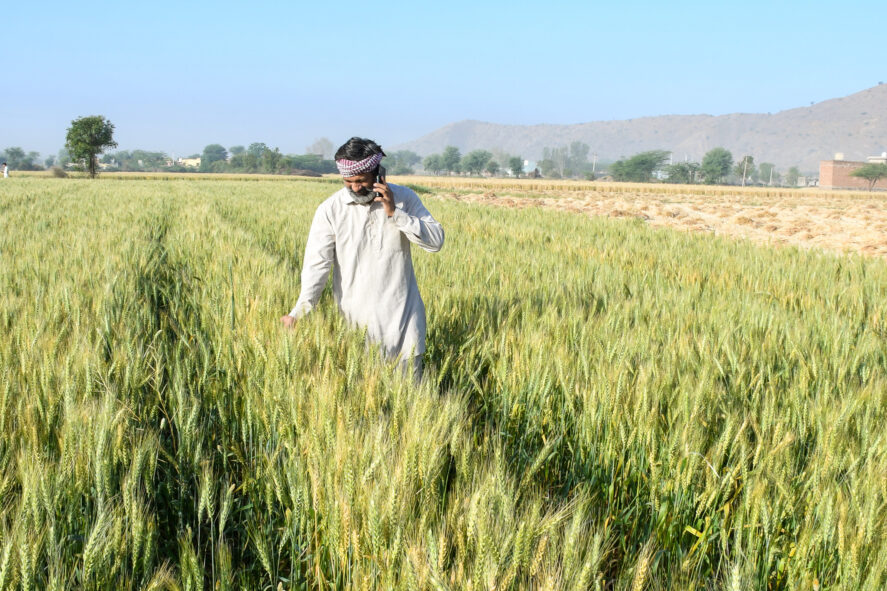
Featured image: A wheat farmer talks on a mobile phone while examining his crops. (Photo by Master of Stocks/Shutterstock)