TCI Challenges Students to Promote Healthy Grains at Food Hackathon
A new challenge at Cornell University’s Food Hackathon will ask students to rethink how underutilized grains like sorghum and millet can be promoted to create value for farmers, manufacturers and consumers.
Scheduled for November 6–8 this year, the Food Hackathon tasks undergraduate and graduate students with addressing one of four challenges related to food systems. As a cosponsor of the event, the Tata-Cornell Institute for Agriculture and Nutrition (TCI) created the new healthy grains challenge, which connects with the Institute’s research on the production of nutrition-rich, environmentally sustainable crops. Additional challenges focus on honey, dairy and fermentation.
Hackathon participants develop their products over the course of two days, receiving advice and support from mentors from Cornell and industry sponsors. They then present their solutions to judges on the final day of the event. Winning teams may receive cash prizes, mentorship opportunities or other awards.
Sorghum and millet are two of the oldest cultivated grains in the world, but have fallen out of favor compared to rice and wheat. Shifting consumer demands for healthy, sustainable foods create an opportunity to expand production and consumption of the grains. They offer several benefits to farmers and consumers alike: they can be grown in challenging conditions, require relatively little water, and boast high amounts of fiber, protein and minerals.
The TCI challenge suggests several avenues for students to approach sorghum and millet. One is to improve their palatability, as they have different flavor profiles and textures than more commonly consumed grains. Another is developing pathways for the grains to be consumed by those most in need of their nutritional benefits. Many current sorghum and millet products are marketed as high-end foods and are too expensive for impoverished consumers. The last route is to improve the value chains for the grains in order to reduce food loss and waste. Because they are bran-heavy, sorghum and millet are more prone to spoilage than rice and wheat.
With the different paths available to students, solutions to the challenge can take a variety of forms, including new food products or ingredients, processing innovations, and digital tools.
To learn more about the Food Hackathon, visit hackathon.cornell.edu/food.
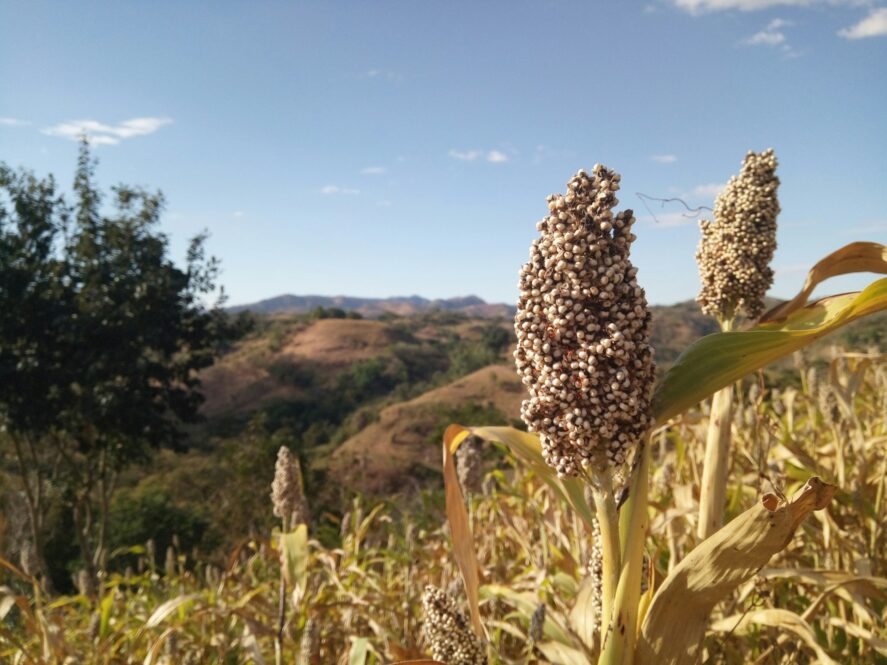
Featured image: Sorghum ripens in a field in El Salvador. (Photo by Luis Rodriguez/Unsplash)