Improved Crop Management Practices Can Help India’s Rice-Wheat Systems
Rice and wheat comprise the bulk of India’s diet, making them crucial crops for the country’s food system. However, the rice-wheat cropping system that dominates agriculture in states like Bihar damages soil quality. Rising temperatures and decreasing groundwater supplies further threaten to reduce yields, posing significant challenges for India’s food security. New research from the Tata-Cornell Institute for Agriculture and Nutrition (TCI) shows that alternative crop management strategies can help to address these challenges by improving soil health.
As the largest cropping system in India, rice-wheat accounts for 18% of total cropped area across the country, especially in the Indo-Gangetic Plain, a large fertile valley that spans northern India and stretches into Nepal and Pakistan. In Bihar, the Indian state where the experiments used in the TCI study were conducted, 70% of farmland is devoted to rice and wheat. Soil health is seriously compromised because farmers in these systems use intensive tillage and flood irrigation to grow their crops, and there is insufficient cycling of organic materials like crop residues and manure because they are used for animal feed and cooking.
In a study published in the journal Plant and Soil, TCI researchers demonstrate that adding organic matter to soil significantly enhances soil health and boosts productivity, especially when combined with reduced tillage.
“These results clearly suggest that soil health and crop yields can be enhanced through better soil management”, said TCI Faculty Fellow Harold van Es, a professor of soil science at Cornell University and co-author of the study.
To assess the impact of such soil management practices, TCI researchers tested soil samples from three long-term rice-wheat crop trials in Bihar. The trials were run by research partners at the Dr. Rajendra Prasad Central Agricultural University (DRPCAU) and the Borlaug Institute of South Asia (BISA). In one experiment, plots of land had different amounts of crop residue—the plant material left behind after harvest—added to the soil. In another, different combinations of residue and manure were added. Another compared different tilling practices, such as no-till farming, in combination with organic inputs. No-till farming, in which seeds are sown mechanically without plowing or turning over the soil, helps by protecting soil from erosion and enabling it to better retain water.
“This study shows that improving soil health can increase yields,” said van Es. “Policies encouraging farmers to use soil-friendly management practices can benefit both farmers and consumers alike through increased production.”
The researchers measured soil health using a comprehensive set of 15 indicators for biological, physical and chemical properties. They consistently identified positive impacts on soil health from the addition of residue and manure, along with no-till farming practices. The biological properties were most responsive to techniques involving greater organic inputs, and the soils’ physical properties were notably improved through less tillage. Chemical properties exhibited slower improvements, including improved pH and increased nutrient uptake.
The researchers also found that zero-tillage and the addition of residue and manure significantly increased yields in connection with the improvements in soil health.
“This study shows that improving soil health can increase yields,” said van Es. “Policies encouraging farmers to use soil-friendly management practices can benefit both farmers and consumers alike through increased production.”
The findings build on a previous study in which the researchers also examined the impacts of reduced tillage and organic soil amendments, but additionally considered the effect of diversified crop rotations, including rice-wheat-mung bean, rice-maize and others. In that study, they similarly found that the use of residue improves soil health and that zero-tillage reduces yields unless accompanied by residue. However, while the researchers discovered that the addition of mung bean to rice-wheat cropping systems increased rice yields, they found that the impact of diversification largely depends on the crop grown and the management techniques used.
“We built a good case for looking comprehensively at the benefits of soil and crop management alternatives, and we now better understand how those benefits may be achieved”, said TCI Faculty Fellow Andy McDonald, a professor of crop ecology and co-author of the study.
TCI alumna Kavya Krishnan was the first author of both studies, which were conducted under TCI’s Optimizing Soil Health project.
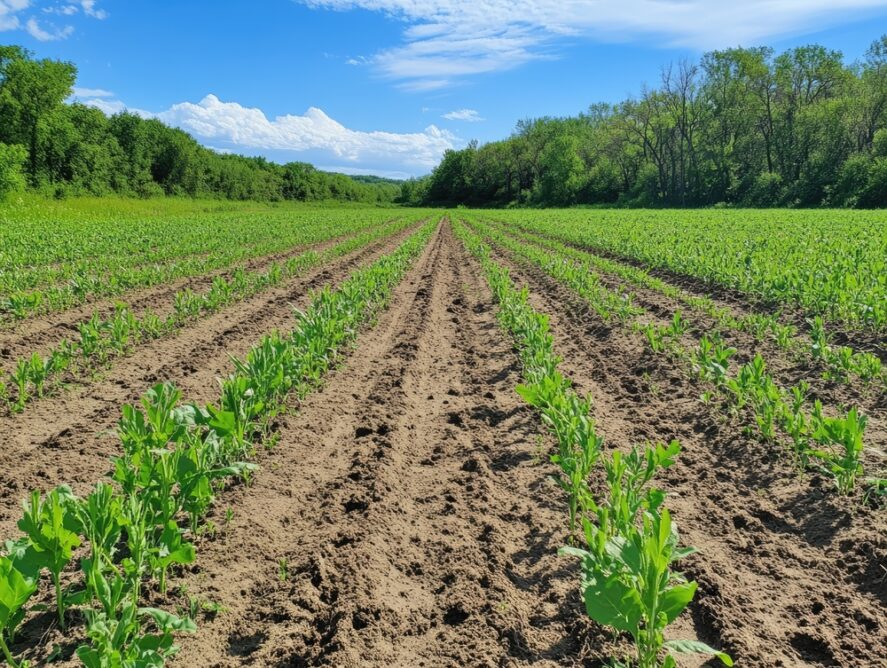
Feature image: The TCI study shows that reduced tillage and the addition of organic materials can improve soil health and boost yields. (Photo by Almahira Hafshah/Shutterstock)