Water User Groups and Solar Irrigation: Lessons from Rural India
Installing a solar-powered pump is only the beginning. What comes next—figuring out how people share it—is a more complex challenge.
During my summer internship with the Tata-Cornell Institute for Agriculture and Nutrition (TCI), I spent my first week visiting solar irrigation sites and the water user groups that managed them across Bihar, Jharkhand and Uttar Pradesh. Before the trip, I assumed the biggest challenges would be technical: financing expensive infrastructure and encouraging farmers to use it. Instead, I kept coming back to a different set of questions: Who decides which fields are irrigated first? What happens when someone doesn’t pay? Who resolves disagreements?
Solar-powered irrigation replaces diesel pumps, allowing farmers to reduce dependence on volatile fuel prices and opening the door to growing higher-value crops. However, solar irrigation infrastructure is expensive. Many smallholders access it through some form of sharing. Across the sites we visited, that meant pooling ownership, buying water from a neighbor, or purchasing irrigation from a private company.
In Bihar, I visited sites built around individual ownership: One farmer owns the solar pump and sells water to neighboring farmers, charging either by the hour or by volume. It was straightforward—the owner decided who received water, and if someone didn’t pay, they would lose access. The key drawback was that the owner still needed enough money to buy the system in the first place. At the sites I visited, nongovernmental organizations (NGOs) helped overcome that hurdle by covering part of the upfront cost. I hadn’t expected individual ownership to feel like a form of sharing, but that’s exactly what it was. The model created a small local market for water instead of requiring farmers to jointly manage the pump.
Jharkhand offered a different model, where neighboring farmers collectively own a solar pump and share water access. In one village, a designated operator managed a pump drawing water from a nearby lake, but decisions ultimately depended on the group rather than a single owner. This model spreads the upfront cost and allows one irrigation system to serve more land than a single household could cultivate. It appeared to work best where farmers already had established groups, such as farmer producer organizations or self-help group, that could provide a foundation for collective decision-making.
The group model is not without its drawbacks, however. One farmer shared that after a bad harvest, several members stopped paying for water. They felt other farmers had received better access, so why should they pay? Without water meters or anyone clearly responsible for resolving disputes, the disagreement lingered. At another site, water shortages led to a simple, but costly compromise: If there wasn’t enough water for everyone, then no one would receive any.
TCI’s Nawada agrivoltaics site in southern Bihar highlighted the successful aspects of the group-based models I saw in Jharkhand. Six farmers managed a shared solar irrigation system powered by a 20-kilowatt array, significantly more electricity than anything I had previously seen. Group size seemed to matter significantly. With only six members, it’s harder for anyone to free-ride unnoticed. Every member is required to be present when a financial decision is made, and each person uses their own key to open the cash box; no one can act alone. The main constraint is regulatory, not organizational. India’s legislative framework doesn’t allow them to sell the electricity the panels generate. The farmers are able to use some of the electricity to power a flour mill, adding value to their harvest.
In Uttar Pradesh, I saw a completely different approach. Instead of farmers owning the pumps, a private company owned more than 300 solar irrigation sites, while local farmers operated each pump. Farmers paid for water by the cubic meter, with every purchase recorded digitally. The company set the price, the meter tracked usage, and the contract defined the rules. Instead of relying on farmers to negotiate access and resolve disputes themselves, the system formalized those decisions through contracts and metering. The tradeoff was that farmers’ access to irrigation depended on the company’s long-term viability. If changes in rural electrification or government subsidies undermined the business model, those effects could ripple across every site the company operated. The model works only as long as the company does.
Water user groups were the most necessary, yet most fragile institution I encountered. Without some form of sharing, solar irrigation remains out of reach for many smallholders. Every model I visited had to answer the same underlying question: How do you create accountability around a shared resource? Individual ownership concentrated those decisions through a single owner, collective ownership relied on farmers coordinating among themselves, and the private company relied on contracts. By the end of the trip, I noticed the strongest groups all seemed to have three things in common: existing relationships, clear rules, and a designated authority to enforce them. Where those conditions were present, the model worked. Where the technology arrived first, and the institutions were expected to follow, the model often failed. The technology was remarkably similar across every site; what differed was how people organized access to it. That, more than the hardware, may determine whether solar irrigation succeeds beyond the pilot stage.
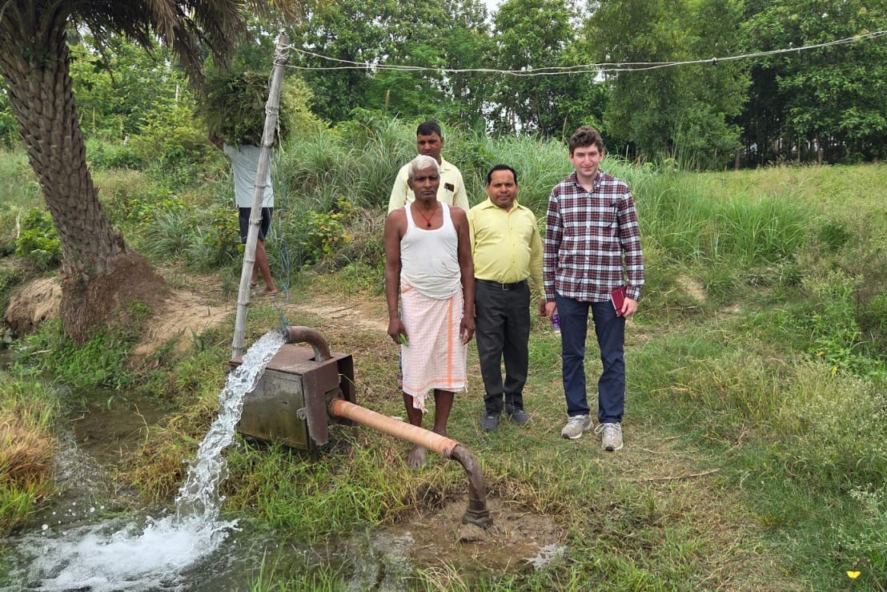
Featured image: Harrison Sachs (far right) visited a solar irrigation site in Northern Bihar with staff from the Aga Khan Rural Support Programme India. (Photo provided)
Harrison Sachs was a TCI intern with the CALS Global Fellows Program in the summer of 2026. He is majoring in agricultural sciences at the College of Agriculture and Life Sciences at Cornell University.