

Research Area: Food & Ag-Science Innovations
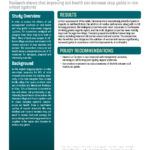
Improved Soil Management Can Boost Yields in Bihar
This policy brief presents the results of a TCI study assessing the effects of different soil management techniques on soil health and crop yields, namely no-till farming and the application of organic amendments. Researchers analyzed soil samples from three long-term trials in Bihar. Plots of...
Organic Inputs and Tillage Differentially Impact Soil Health and Yield in Rice–Wheat Systems in the Eastern Gangetic Plain
Abstract Background The rice (Oryza sativa L.) – wheat (Triticum aestivum L.) rotation is the dominant cropping system of the Indo-Gangetic Plain and is experiencing challenges from a variety of environmental and socio-economic factors. Organic matter cycling and zero-tillage (ZT) have been encouraged in the...
Agricultural hotspots in India: Evidence from paddy, wheat, and millets
Abstract We analyze district‑level data for paddy, wheat, and millets (2010–2019) across India to identify yield hotspots with consistently high or rising productivity and coldspots with persistent declines. Spatial clustering and regression analyses show that weather, irrigation, fertilizer use, and farmers’ mobile-based information access shape...
Soil Health-Human Health Nexus: Mineral Thresholds, Interlinkages and Rice System in Jharkhand, India
Abstract Understanding the role of minerals along biological pathways in the food chain (soil-crop-animal/human) is imperative to solving the global problem of human malnutrition and toxic exposure. This is especially relevant to rice (Oryza sativa L.)—a staple crop in highly populated regions, like India, that are...

Enhancing Soil Health in Rice Cultivation: Optimized Zn Application and Crop Residue Management in Calcareous Soils
Abstract Crop residue, a readily available biomass, is the largest source of organic matter in soil, and zinc (Zn) significantly influences microbial activity. Understanding the optimal Zn rates for enhanced biological activity in crop residue-amended soils is crucial. A study at RPCAU, Pusa, examined the...
Seasonal Variations in Soil Characteristics Control Microbial Respiration and Carbon Use Under Tree Plantations in the Middle Gangetic Region
Abstract Seasonal variations directly impact the biochemical and microbial properties of the soil, influence carbon and nutrient cycling within the soil system. Soils under tree plantation (TP) are rich in organic matter and microbial population, making them more susceptible to seasonal variation. We studied the...
A Data-Driven Approach for Devising and Assessing Precision Nitrogen Management Strategies Applied to Wheat Systems in India
Abstract Limiting nitrogen pollution from crop production is essential for mitigating greenhouse gas emissions and protecting aquatic ecosystems while maintaining food security. Precision nitrogen management (PNM) provides a conceptual framework for achieving yield goals while maintaining nitrogen pollution within planetary boundaries by matching fertilizer rates...
Agronomic enhancements in the Indo-Gangetic Plain variably improve soil health depending on tillage and residue management
Abstract Changing climates, labor markets, scarcity of water and soil degradation threaten productivity in rice (Oryza sativa L.) – wheat (Triticum aestivum L.) rotations the eastern Indo-Gangetic Plain (IGP). Diversifying cropping systems, zero tillage, and residue addition can improve soil health and lead to increased system yields....
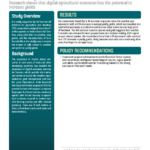
Maximizing the Impact of Kisan Call Centers
This policy brief presents the results of a TCI-supported study that assessed the impact of digital agricultural extension services in India. Researchers analyzed more than 17 million queries to India’s Kisan Call Centers, along with data on weather, crop yields, and the characteristics of farm...

The Role of Genotyping in Measuring Improved Variety Adoption and Impact: Advances, Challenges, and Policy Directions
Abstract Accurate measurement of agricultural technology adoption is critical for evaluating the effectiveness of investments in agricultural research and development. While household surveys have long served as the primary tool for tracking varietal adoption, growing evidence reveals systematic mismatches between self-reported and DNA verified varietal...