Key Findings from TCI’s Report on FPOs in India
Last month, we published “The State of Farmer Producer Organizations in India: Performance, Trends, and the Role of Gender.” The report offers an assessment India’s farmer producer organization (FPO) ecosystem, including survival rates, financial performance and governance models. In addition, the report focuses on the role of gender in shaping FPO outcomes and includes case studies of women’s self-help groups that successfully transformed themselves into FPOs.
From our quantitative analysis of 44,547 farmer producer companies (FPCs) and 214,797 agricultural producer companies (APCs), along with the aforementioned case studies, TCI researchers made the following discoveries:
Farmer producer organization growth and compliance
- There have been 259,344 FPOs promoted in India, with 44,547 promoted as FPCs and 214,797 promoted as APCs. Overall FPO annual growth has been at its highest in the last 5–10 years, with 9,000 FPCs promoted and 6,000 APCs promoted each year.
- Not all promoted FPOs continue to function. We estimate that 43–49 percent of all promoted FPCs continue to operate after government support has ended; 23 percent of FPCs access credit; and 72 percent of all APCs remain functional.
- FPCs with women in leadership demonstrate superior survival rates. Female-led and mixed representation FPCs make up only 15 percent and 13 percent of all FPCs, respectively, but have compliance rates 4–13 percent higher than their male-led counterparts.
- Women-led FPCs are not promoted equally across Indian states. Women-led FPCs range from 1 in 3 FPCs in Jharkhand to 1 in 20 FPCs in Haryana.
- Small, medium, and large FPCs have similar compliance rates. Older FPCs tend to be large and recently promoted ones tend to be small, indicating that either large FPCs tend to survive longer or that FPCs that grow over time tend to survive.
- APC performance varies by state/union territory and sector. Broader trends are largely indiscernible, indicating success rates may be state- or sector-specific.
Farmer producer company characteristics and support
- The choice of implementing agency and CBBO may influence the characteristics of FPCs, such as the gender composition of the leadership team and agricultural focus areas.
- Large corporations and consultancies have recently begun acting as CBBOs to promote FPCs. These include ITC, Bayer, Grant Thornton Bharat LLP, and PricewaterhouseCoopers (PwC). Their influence on FPC characteristics requires further examination.
- FPCs exhibit distinct regional specialization patterns, driven by agroclimatic advantages and institutional approaches. Although basic crops like grains and vegetables are widely distributed, specialized products like forest products and nuts show high geographic concentration.
- Our limited data showed that women-led FPCs pursue distinctly different agricultural and business strategies, focusing more on animal agriculture, traditional crops, and processing activities. They also remain underrepresented in high-value commercial crops and business activity reporting.
Financial performance
- Large FPCs consistently outperform smaller organizations across most financial metrics. They demonstrate better capital utilization, stronger profitability, more effective debt management, and superior operational efficiency. The performance advantages of larger FPCs suggest that policies that encourage growth, consolidation, or federation of smaller companies could improve overall sector effectiveness.
- Women-led FPCs outperform their male-led and mixed-led counterparts in most financial metrics. Women-led FPCs demonstrate higher profitability, improved liquidity management, more conservative yet effective debt utilization, and efficient operations.
- Financial performance exhibits strong regional clustering, with certain states consistently producing better results. This may suggest that local market conditions, infrastructure, policy support, and institutional ecosystems may significantly influence FPC success. The geographic clustering of successful FPCs indicates that region-specific strategies addressing local market conditions, infrastructure, and institutional support could improve outcomes in underperforming areas.
- Low debt utilization across FPCs likely reflects limited access to formal credit, rather than purely conservative financial management. This constrained access may limit growth potential and operational flexibility.
- High standard deviations across most measures indicate significant variability in performance, suggesting that while some FPCs achieve strong results, others face substantial difficulties. Systematic performance monitoring and targeted interventions for struggling FPCs could prevent failures and improve the overall health of the sector.
Self-help group-to-farmer producer company transition
- SHGs can serve as effective incubators for agricultural collectives, but transitioning requires external facilitation by civil society organizations, which leverage existing trust networks to mobilize women into market-oriented enterprises. This highlights the importance of institutional intermediaries in overcoming information asymmetries and capability gaps that hinder spontaneous collective action.
- Women-led FPCs demonstrate competitive advantages over male-led organizations through superior group cohesion, financial discipline, and democratic governance—attributes directly traceable to SHG experience. Financial performance analysis reveals significant heterogeneity, with profit margins ranging from 0.26 percent to 86.71 percent, reflecting different value chain positioning as high-value dairy products outperform commodity markets.
- Women–led groups show adaptability when facing structural constraints. Land, resource, and market access barriers have led to innovative responses, including food processing, mushroom cultivation, forest product collection, and dairy procurement, which circumvented ownership requirements while maintaining an agricultural focus.
- FPCs function as market-making institutions rather than simply aggregating existing participation, by establishing quality standards, coordinating input procurement, and facilitating direct buyer relationships to create market conditions which individual farmers could not access independently. Although social capital effectively explains transition dynamics, external policy support, civil society organization facilitation, and market opportunities emerge as essential factors.
- Women’s collectives can serve as effective vehicles for agricultural development when supported by appropriate policies and institutional frameworks along with sustained commitment to addressing gender-specific constraints.
“The State of Farmer Producer Organizations in India” is available for download as a PDF.
Dan Verderosa is the communications and outreach manager at TCI.
Dieter Bouma is a research support specialist at TCI.
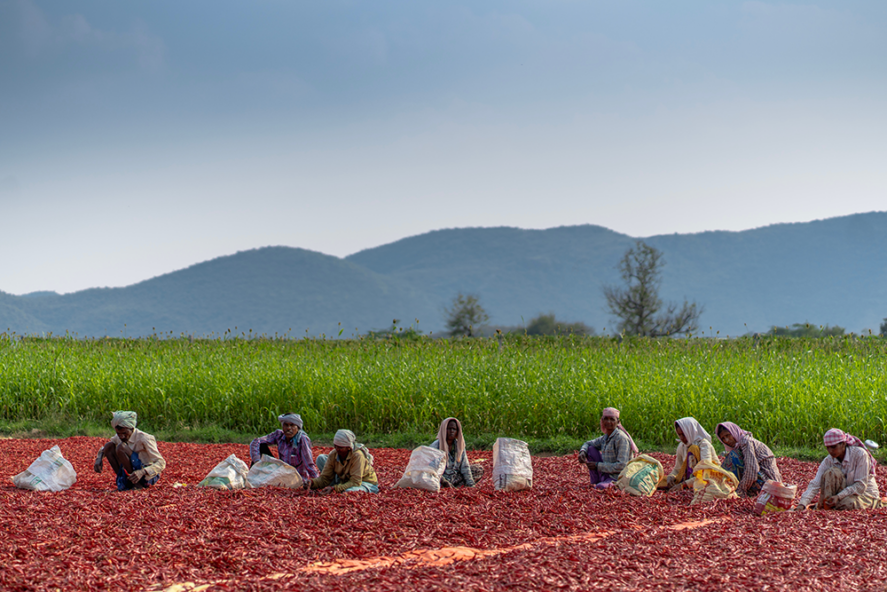
Featured image: Women farmers sort through chili peppers in a field. (Photo by Jeni Photography/Shutterstock)