
From MGNREGA to VB-G Ram G: A Field Researcher’s Take
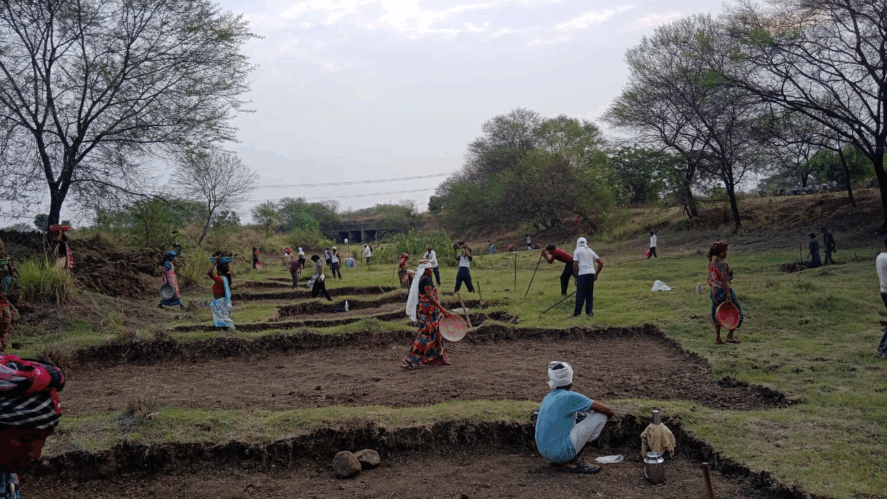
On December 18, 2025, the Indian government passed the Viksit Bharat—Guarantee for Rozgar and Ajeevika Mission (Gramin) (VB-G Ram G) bill in both houses of the parliament, proposing to replace the nearly two‑decade‑old Mahatma Gandhi National Rural Employment Guarantee Act (MGNREGA). The bill promises 125 days of wage employment—25 more than the current guarantee—alongside weekly wage payments and digital governance reforms. Yet, beneath these headline improvements lies a fundamental restructuring that has triggered fierce debate among economists and policymakers. Does this new law modernize India’s flagship social protection program, or does it dismantle the rights‑based architecture that has sustained millions of rural households through natural disasters and economic downturns?
As a researcher documenting the lived realities of MGNREGA workers in rural India, this is not an abstract question. For women like Kusum‑bai, a landless worker I met in Chandrapur, Maharashtra, while doing my fieldwork, the job card is not just administrative paperwork; it is a lifeline that prevents distress migration when local farm work dries up. The new law will shape what that lifeline looks like for her and millions of others.
More days, faster pay, “better” assets
At first glance, VB‑G Ram G appears to strengthen rural employment guarantees. The increase from 100 to 125 days potentially raises annual household earnings by 25%, a significant bump for families at the bottom of the income distribution. In Maharashtra, where the current MGNREGA wage rate is $3.5 per day for 2025–26, a household completing 125 days could earn roughly $433 annually, compared to $347 for 100 days, a theoretical gain of $87. For households in Arunachal Pradesh and Nagaland, where wage rates are around $2.7 per day, the additional 25 days still translate into over $67 a year, enough to cover a year’s school fees or an emergency hospitalization.
The shift to weekly wage disbursement is also welcome. Under MGNREGA, wages are supposed to be paid within 15 days of muster roll closure, but field studies consistently document delays stretching months, particularly in areas with weak banking infrastructure. Research shows how such delays undermine the scheme’s role as a consumption‑smoothing mechanism, forcing households to borrow at high interest while waiting for wages. If implemented with adequate banking and fund‑release systems, weekly payments could reduce emergency borrowing and make the program more compatible with people’s cash‑flow needs.
VB‑G Ram G retains provisions for works on individual land belonging to vulnerable households, such as farm ponds, horticultural plantations, and land development for lower-caste families. In rural Maharashtra, I have seen how such works help smallholders improve soil moisture, stabilize yields and reduce their need to migrate in lean years.
The new law also sharpens the focus on work quality, channeling works into four priority groups: water security (harvesting structures, groundwater recharge), core rural infrastructure (roads, connectivity), livelihood infrastructure (storage, markets) and climate mitigation (afforestation, drainage). The stated intent is to move beyond “digging holes” toward durable assets integrated with growth and climate goals. Importantly, VB‑G Ram G retains provisions for works on individual land belonging to vulnerable households, such as farm ponds, horticultural plantations, and land development for lower-caste families. In rural Maharashtra, I have seen how such works help smallholders improve soil moisture, stabilize yields and reduce their need to migrate in lean years.
Historically, MGNREGA funds have also supported household‑level sanitation and drinking water facilities. Whether these will continue, and how they will be classified within the new “core rural infrastructure” basket, remains an important open question for village‑level planning.
Digital governance reforms such as GPS‑tagged works and biometric authentication aim to prevent fraud. By 2024, 99.9% of MGNREGA payments were made electronically, sharply reducing classic “ghost worker” fraud. In principle, the proposed “Viksit Bharat Rural Infrastructure Stack” could further improve transparency.
However, my field observations temper any optimism. For illiterate workers and local functionaries like rojgar sevaks in remote villages, each new app or biometric requirement adds complexity. Errors in Aadhaar seeding, network failures and confusing interfaces often turn a simple demand for work into an intimidating bureaucratic maze, eroding trust rather than building it.
Normative allocation and the 60:40 split
These improvements come with a very different fiscal and legal design. The biggest change is the shift from a demand‑driven labor budget to a centrally fixed “normative allocation.” Under MGNREGA, states draw up annual labor budgets based on decisions and expected demand coming from village-level stakeholder meetings, and the central government is, in principle, obliged to provide funds. Under VB‑G Ram G, the central government will instead set a state‑level ceiling at the start of the year using “objective parameters,” and any spending beyond that limit must be paid for entirely by the state government. The law itself does not define what these “objective parameters” are; it only says the central government will specify them later in the rules. In similar centrally sponsored schemes, such formulas often mix indicators like rural population, poverty and past utilization, which can end up penalizing states that already struggle with weak implementation. Until the parameters are made public, states will have little clarity on how their ceiling is calculated or how it might change over time.
This is not a minor technical shift. As many economists have put it, “when funds run out, rights run out.” During the 2020–21 COVID‑19 lockdown, MGNREGA person‑days shot up by around 40% as reverse migration brought millions back from cities to rural areas. The central government responded by releasing additional resources mid‑year, taking total expenditure to about $12.33 billion. That counter‑cyclical response was possible only because the law recognized demand as the starting point. Under a normative allocation, a similar surge could be met with a simple bureaucratic response: the state’s quota is exhausted.
Economic theory and experience tell us that sub‑national governments with hard budget constraints often cut or ration welfare precisely when need is highest. VB‑G Ram G thus creates powerful incentives for states to limit work demand…
The new 60:40 center-state funding pattern compounds this problem. Under MGNREGA, the central government bore almost all of the unskilled wage bill, with states paying the unemployment allowance and a share of the material component. VB‑G Ram G now requires most states to pay 40% of wages (with a 90:10 pattern for northeastern and Himalayan states).
For Maharashtra, in 2024–25, total MGNREGA expenditure on wages was around $600 million. If we apply the new 40% wage share rule, then the state will have an additional burden of over $240 million annually. This comes on top of the Mukhyamantri Majhi Ladki Bahin Yojana, which provides $167 per month to eligible women and is estimated to cost about $5.11 billion a year. Maharashtra is not alone. Twelve states are now running women’s cash transfer schemes, together spending roughly $18.67 billion annually on about 118 million women. In this fiscal context, asking such states also to absorb 40% of a legally mandated wage bill is not neutral technocracy; it is a political choice about who will be forced to say “no” at the village level.
Economic theory and experience tell us that sub‑national governments with hard budget constraints often cut or ration welfare precisely when need is highest. VB‑G Ram G thus creates powerful incentives for states to limit work demand, for example, by not opening worksites, by slowing down approval of new works, or by discouraging applications once the central-government-set ceiling is in sight. In states where officials already struggle to cope with MGNREGA—like Bihar and Uttar Pradesh, which have chronically underutilized central funds despite high poverty—an added fiscal hurdle is more likely to shrink the program than to improve it.
State capacity: five states, three lessons
Interstate evidence over the past decade reveals sharply diverging paths of MGNREGA implementation.
- Bihar and Uttar Pradesh sit at the bottom of most performance indices. Studies and audits document low average days of employment, weak registration of demand, delayed payments, and administration that is often overwhelmed or indifferent. Despite high rural poverty, these states have often generated far fewer person‑days than their allocations would allow.
- Tamil Nadu and Himachal Pradesh, by contrast, consistently appear among the top performers. They generate high person‑days per household, have relatively timely payments, and have used MGNREGA to build water harvesting and land development assets that communities actually value. In Tamil Nadu’s 2016–17 drought, village meetings and civil society advocacy leveraged the legal guarantee to push the central government for additional funds.
- Karnataka, despite having a stronger fiscal base than Bihar or Uttar Pradesh, is grouped with the worst performers on composite intensity indices, showing that fiscal capacity without political and administrative commitment does not automatically translate into better implementation.
VB‑G Ram G’s architecture assumes that making states pay more and live within a fixed envelope will generate ownership and efficiency. The interstate record suggests a different risk: low‑capacity and fiscally weaker states may simply retreat further, while relatively capable states lose the flexibility that made them successful in crises. For example, Maharashtra, which the data often describe as “medium intensity, moderate coverage,” now has to navigate this new terrain with already stretched finances and multiple competing welfare commitments.
The 60‑day pause
The legally mandated “pause” of up to 60 days during peak agricultural seasons has already drawn attention. Section 6(1) of the Act allows states to name sowing and harvesting periods during which no VB‑G Ram G works may be undertaken. The government’s justification for the 60‑day pause rests on two main claims. First, MGNREGA has raised farm wages and contributed to labor scarcity during critical operations. Second, the scheme was always meant to be a lean‑season buffer rather than a competitor for peak‑season farm work. Studies do show higher rural wages and some farmer reports of tighter labor markets in high‑intensity MGNREGA areas, which the government interprets as a rationale for shifting public works away from sowing and harvesting windows.
But turning this concern into a blanket legal ban overshoots the evidence. National data indicate that MGNREGA demand already dips in peak months, and the real problems farmers face are rooted in historically low wages and delayed payments rather than an unconditional “crowding out” of labor. Research finds that in districts where the program was implemented, agricultural wages rose, reflecting workers’ improved outside options. A statutory pause effectively removes landless workers’ only credible outside option just when their bargaining power is highest, weakening the very right the program was designed to secure.
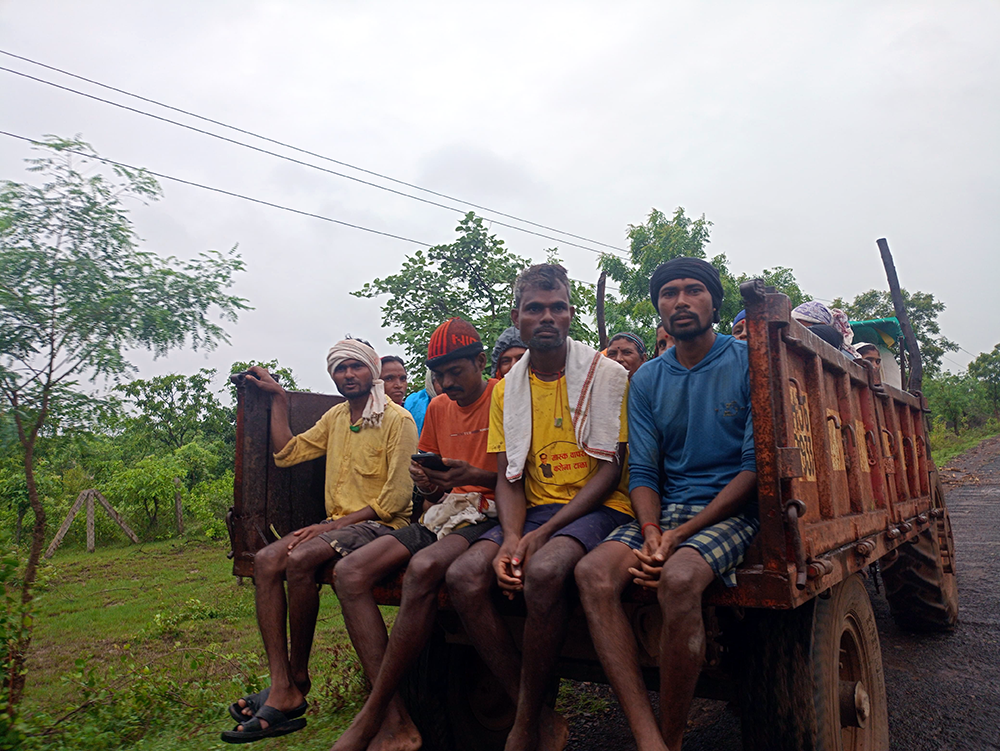
Laborers migrate to the nearest town after MGNREGA work winds down in their area. (Photo by Kasim Saiyyad/TCI)
In Maharashtra, the agricultural calendar is neither uniform nor predictable. Landless women often piece together their year in small segments: a few weeks of weeding here, a harvest there, with MGNREGA work that fills the lean gaps. Many lower‑caste women I spoke to reported being offered private wages that were one‑third of the MGNREGA wage. The ability to say, “No, I will work on the government site instead,” is not just about money; it is about dignity and bargaining power.
One of MGNREGA’s original objectives was to reduce distress migration by providing proximate, predictable work. A seasonal pause risks reversing that logic. Faced with no local public work and low private wages, households do what they have always done in the absence of safety nets—they migrate. For the landless in eastern Maharashtra, this often means cutting sugarcane in western Maharashtra, operating brick kilns in Telangana, or seasonal construction work in cities. The costs are well documented: disrupted schooling for children, poor nutrition and health at destination worksites, and increased vulnerability to accidents and debt bondage.
The pause will also impact with intra‑household gender dynamics. When men migrate and women stay behind, MGNREGA can provide an independent income stream that strengthens their decision‑making and dietary diversity, as my own work and other studies have documented. Curtailing the program in peak seasons may disproportionately harm women’s autonomy.
Decentralization and digital control: Whose program is it?
The move from MGNREGA to VB‑G Ram G is also a move from a rights‑based law to a centrally steered “mission.” MGNREGA’s preamble and design explicitly articulated an enforceable right to 100 days of work, with decentralized village meetings at the heart of planning. When I attended some of these meetings in eastern Maharashtra, villagers argued over which water bodies to deepen or which roads to prioritize, and passed work resolutions by a show of hands. These were messy, imperfect exercises, but they were recognizable as local democracy.
VB‑G Ram G retains some of this structure on paper, but the balance of power shifts. The emphasis on a “Viksit Bharat Rural Infrastructure Stack,” GIS‑based planning and normative asset templates gives higher tiers of government more control over which works are permissible and where. Technology can certainly help identify gaps and avoid duplication. But when combined with fiscal caps and state co‑financing, it also risks recentralizing power; The right to demand work becomes constrained not only by money, but by what fits into centrally approved work menus and dashboards.
Embedding these systems in statute without equally strong, accessible grievance redressal mechanisms risks locking in technological failure modes that are much harder to contest than a missing entry on a paper muster roll.
Fiscal realism without hollowing out rights
The debate over VB‑G Ram G is ultimately about what kind of state India wants to be for its rural citizens. The bill embodies a form of fiscal realism: central governmentwants predictable liabilities, states are being asked to put “skin in the game,” and digital tools promise cleaner implementation. These are not trivial concerns.
But the evidence from MGNREGA suggests that the features being watered down—open‑ended central funding, demand‑driven planning and the absence of seasonal suspensions—are precisely what made the law effective during crises. A study by the World Bank Economic Review estimates that MGNREGA lifted around 14 million people out of poverty in its first decade, the majority of whom lived in states with stronger implementation. Those gains depended on the ability to scale up when distress hit.
As VB‑G Ram G moves from law to implementation, three questions deserve sustained attention:
- Can fiscal caps and cost‑sharing be designed in ways that do not punish poorer, low‑capacity states or fiscally stressed states already running large cash‑transfer schemes for women, like Maharashtra?
- Can the 60‑day pause be rethought so that it does not undercut the program’s role in setting a wage floor and reducing distress migration, especially for landless, lower‑caste women?
- Can digital and normative planning tools be layered onto, rather than replacing, village‑based decentralization and robust, low‑friction grievance systems?
For the women of rural Maharashtra, beneficiaries of both Ladki Bahin cash transfers and MGNREGA, VB‑G Ram G currently looks like a mixed bag. It offers more days on paper and faster pay in principle, but under conditions that make those offers harder to claim: capped budgets, shared state liabilities, a seasonal pause, and more central steering of local works. If Viksit Bharat is to mean anything substantive for them, the state must find ways to align fiscal discipline with the spirit of a genuine employment guarantee, not replace one with the other.
Only then will the job card remain, in Kusum‑bai’s words, something that “opens the government’s coffers” when everything else fails, rather than a card that reveals, each year, how little is left in the state’s envelope.
Kasim Saiyyad is a TCI scholar and PhD student in the field of applied economics and management.
Featured image: Laborers work on an MGNREGA project in Maharashtra, India. (Photo by Kasim Saiyyad/TCI)