
TCI Director Co-Edits New Book on Agricultural Technology
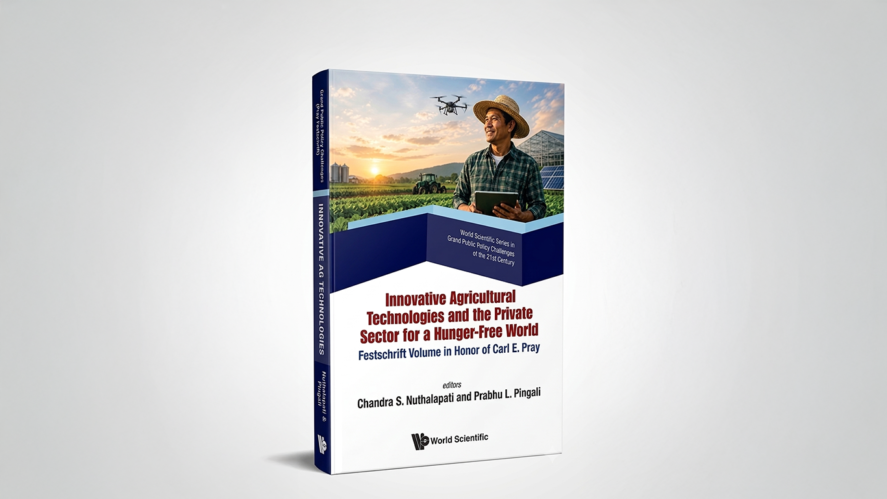
Tata-Cornell Institute for Agriculture and Nutrition (TCI) Director Prabhu Pingali and Chandra S. Nuthalapati, a former visiting professor at TCI, co-edited a new book, “Innovative Agricultural Technologies and the Private Sector for a Hunger-Free World.” The book was published in honor of the economic historian Carl E. Pray.
The fifth volume in the World Scientific Series in Grand Public Policy Challenges of the 21st Century, the book explores the challenges of food production and food security through the lens of innovation in agricultural technologies, seed systems, institutional frameworks, and human capital development.
The book is rooted in the “agricultural innovation system” framework, a model that treats agricultural development as an interactive network, rather than a linear process, as well as Pray’s contributions to food systems discourse. Pray was a distinguished professor in the Department of Agricultural, Food and Resource Economics at Rutgers University. He retired in January 2026 after a 40-year career, during which he made significant contributions to agricultural science and technology policy.
“Carl Pray has consistently been ahead of the curve with forward-looking ideas and impactful insights, and this book is a testament to that legacy,” Nuthalapati said. “His work significantly influenced food policy decisions in several developing countries and was instrumental in promoting private sector engagement aimed at enhancing food security and improving the livelihoods of smallholders.”
The book is structured in three thematic parts, with 15 chapters authored by leading scholars and experts. Part one explores global agricultural productivity and structural transformation for sustainable growth. It revisits the legacy of the Green Revolution, examines the complexities of diversifying beyond staple crops, and evaluates the promise and pitfalls of genetically modified and gene-edited crops. Part two focuses on the emergence and evolution of dynamic seed industries in Argentina, Brazil, India and China. The chapters investigate the drivers of innovation, institutional change and market development in these key countries. Part three analyzes how breeding value chains evolve alongside modern product value chains. It highlights the role of agri-tech startups in emerging economies and innovative pedagogies for teaching private-sector innovation, in addition to offering insights from China on educating rural populations and bridging the rural-urban divide.
In addition to editing the volume, Pingali and Nuthalapati also co-authored a chapter in the book’s first section, titled “Crop Biotechnologies: Unfulfilled Promises and New Opportunities with Gene Editing Technologies.” The chapter assesses the reasons that genetically modified crops have only made limited contributions to food security and offers policy recommendations to ensure that gene-edited crops currently under development advance food security and improve farmers’ livelihoods.
Feature image: “Innovative Agricultural Technologies and the Private Sector for a Hunger-Free World” was published by World Scientific. (Image created using AI)