Why Women Want to Work but Don’t: Aspirations, Constraints and Reality
Women want to work. They want to step outside the house, earn an income, and feel the quiet satisfaction of being independent, of taking pride in something that is theirs. Even a small earning carries meaning: the ability to contribute to household expenses, to buy gifts for the children, to feel that one belongs to the world beyond the home. More than money, it is about having an identity of their own.
Talking to married, unemployed women in the villages of West Bengal made this unmistakably clear. The aspiration is there—vivid, consistent and deeply felt. But aspiration alone is not enough. At every step, constraints close in. Marriage brings with it expectations of obedience to a husband, to in-laws, and to the unending demands of running a household: cooking, cleaning, keeping everything in order. Children add another layer entirely. Caring for them is not a task; it is a vocation. And so, quietly, the desires and aspirations get set aside. Life moves on, and they remain behind.
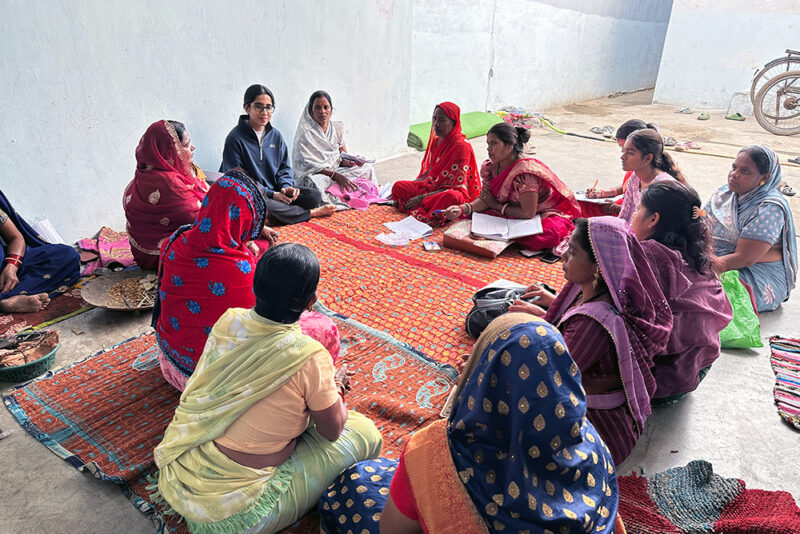
As part of my doctoral research and ongoing fieldwork to understand barriers to married women’s labor supply and to test novel interventions aimed at increasing it, I surveyed 801 married, unemployed women across 18 villages. Sitting across from them, in household after household, I asked a simple question: do you want to do paid work? Nearly every woman said yes. Ninety-seven percent of women in my sample expressed a desire to work. That number stopped me. This was not a story about missing aspirations. And yet only about one in three women in the sample had ever held a paid job. The gap between wanting to work and actually working is not marginal.
The barriers are many, and they stack
When asked what stops them from working, women cited multiple, overlapping constraints. Household chores were the most commonly reported barrier (75%), followed by childcare (70%), the need to care for elderly family members (40%) and safety concerns (20%). The barriers are not discrete hurdles but a cumulative load, and clearing one does not clear the others.
Location adds yet another layer. When asked where they would be willing to work, 98.7% said they would accept work from home. That share falls to 86.4% for work within the village, 46.3% for work nearby but outside the village, and just 5% for work that is far away. Women are not unwilling to work, but they are unwilling, and often unable, to travel far to do it. Every kilometer of distance is a negotiation with family, with the logistics of childcare, with safety. The wage, it turns out, is almost secondary to where the work happens.
Even when a woman wants to work and an opportunity exists, the decision is rarely hers alone. When asked who would have the final say on whether they could take up employment, 63% of respondents said it rests with their husbands. Only 11.6% said the choice was theirs to make. Another 22.8% described it as a joint decision, and 2% cited in-laws. In nearly two-thirds of households, a woman’s desire to work is, in the end, subject to someone else’s approval.
Aspirations adapted, not abandoned
What is perhaps most striking is not just that women want to work, but how they want to work. Their aspirations have been quietly shaped by the very constraints that surround them. When asked what kind of work they would most want to do, 70% chose handwork and bag-making, and 65% chose tailoring—both activities that can be done from home, on flexible hours, without stepping outside or seeking permission to leave.
This shows up just as clearly in training preferences. Women chose tailoring and embroidery (52%), handwork (42%) and cooking and food processing (22.3%)—all home-compatible skills. Even among the more outward-facing aspirations—Anganwadi worker (38.6%), beauty salon worker (25%), government clerk (23%), teacher (20%)—the pattern holds. Women are gravitating toward work that either happens at home or carries low social stigma—professions where a woman working is seen as respectable, even expected. Only 14% expressed interest in starting their own business.
When asked about desired monthly income, the mean response was ₹7,860 and the median was ₹7,000—modest figures by any measure. More striking still, 89% of women said they would be willing to work for even less than their stated preferred wage. And the time they could offer? A mean of just five hours per day, reflecting not low ambition, but the tight squeeze of daily life that leaves little room for anything beyond it.
The village talks, and it is costly
The social weight behind these choices is captured in one figure: 64% of women said people in their community speak badly of women who work for pay. Paid employment, for a married woman, can signal that her husband is unable to provide—a reputational cost that falls not just on her but on her household. Choosing tailoring done quietly at home over a job that requires stepping outside is, in this context, not a failure of ambition. It is a rational response to a social world that penalizes visibility.
We know the barriers. We need the way.
These women’s aspirations are real. But they have been quietly bent around stigma, norms, permission structures and the question of what kind of work a woman can do without reputational cost to herself or her family. The data tells a story of enormous, largely untapped potential; potential that exists not in spite of these women, but in them, waiting. This fieldwork reminds me that behind every number is a woman who already knows what she wants. Understanding what stands in her way, and finding answers to how she can achieve what she aspires to, is where the work begins.
Apurva Borar is a TCI scholar and PhD candidate in the field of applied economics and management at Cornell University.
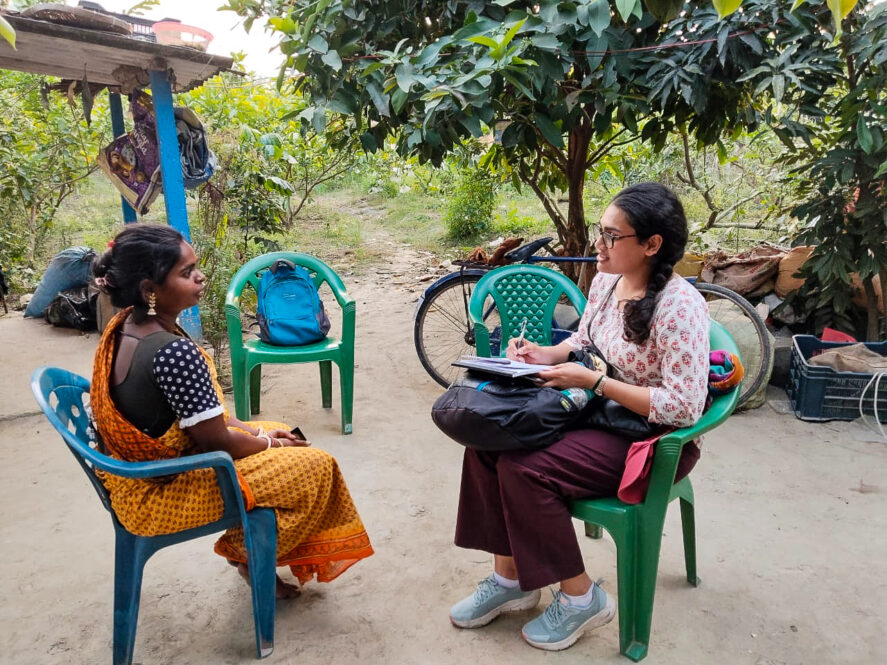
Featured image: Apurva Borar interviews a woman during her field-based research. (Photo provided)