
The Formal Supports the Informal: Agricultural Technology Sharing in Southern Bihar

Across a village in southern Bihar, cropping calendars collapse into a handful of critical days. Missing the planting window by even a couple of days can reduce yields enough to affect a household’s livelihood. Everyone needs the same machine at once, but most smallholders cannot afford to own a tractor or combine harvester themselves. Instead, they access machinery through informal borrowing from neighbors or formal rentals through custom hiring centers (CHCs).
I spent the penultimate week of my internship with TCI on field visits in the south of Bihar, trying to better understand how smallholder farmers access technology. What fascinated me was how villages organize access to something that almost nobody can afford to own individually.
I met with a women’s self-help group, formed in 2010 under Bihar’s rural livelihood mission, JEEViKA, to organize women around savings, credit and livelihood security. The group ran on that basis for ten years before taking on ownership of a CHC in 2020. It has since grown to over 600 members. The self-help group owns the equipment; group fees cover repairs and maintenance.
Before visiting, I assumed a CHC would try to replace the informal lending system. I thought that once the tractor was fully booked, farmers would just fall back on borrowing from neighbors. Instead, the opposite occurs. Informal lending was the original mechanism, and the CHC came later because those informal channels were overcrowded during the few days a year when everyone needs the same machine. The formal institution acts as an overflow valve, not the primary reservoir.
The informal system wasn’t failing. It just couldn’t fulfill everyone’s needs when the whole village needed the same tractor in the same narrow window. The informal system’s advantage is that it’s already embedded in the village’s existing relationships. It gives the lending neighbor an extra cash flow that helps finance their own machine, and because there are several neighbors with tractors rather than one central operator, it offers more total points of access.
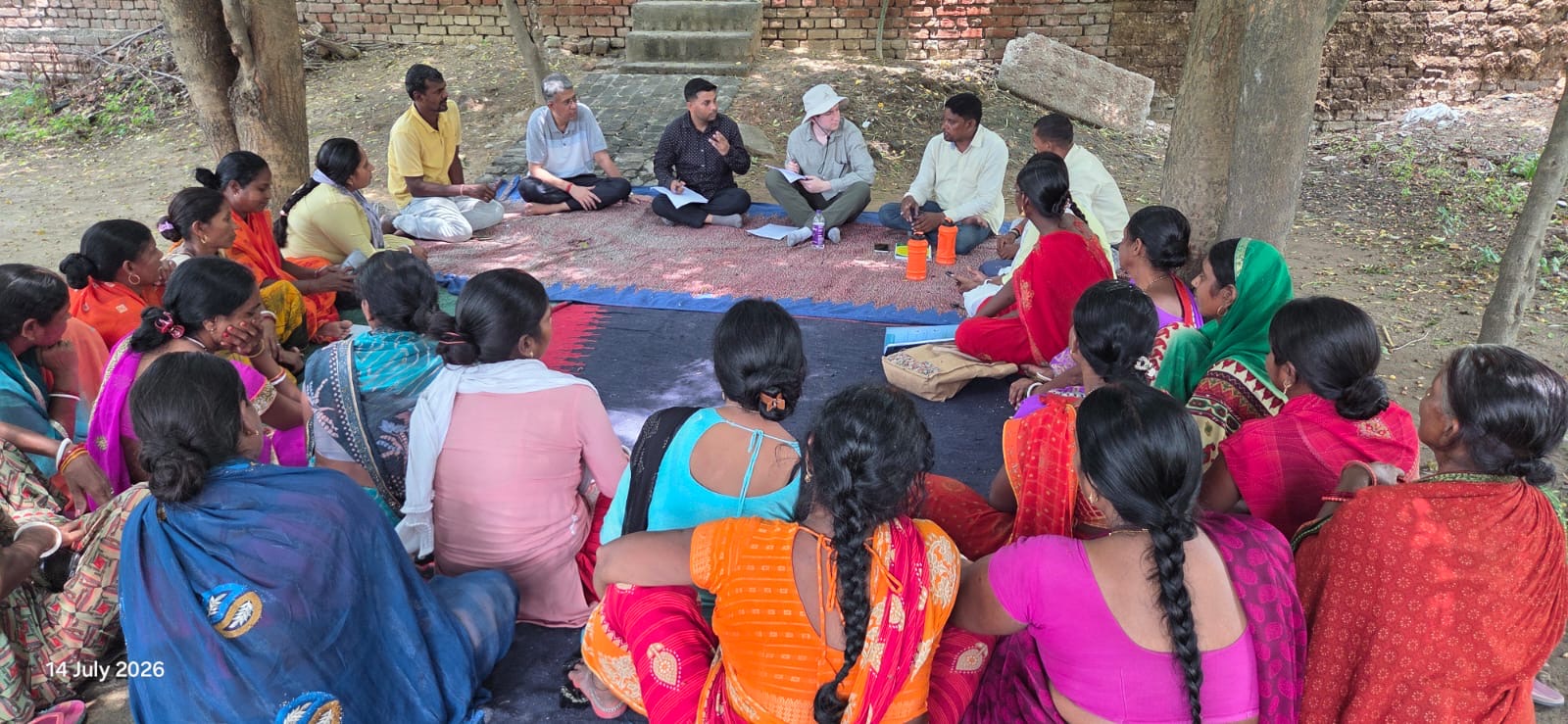
TCI intern Harrison Sachs interviewed members of a women’s self-help group to learn more about how Indian farmers access agricultural technology. (Photo provided)
Even with both systems running, demand isn’t always fully met. The gap looks less like a straightforward shortage of machines and more like a coordination problem. When the entire village needs the same machine during the same window, simply increasing the supply doesn’t smooth out the scramble. The CHC eases that bottleneck, rather than erasing it.
Power dynamics still appear. A machine spends more hours on the bigger plots in the village. With booking operators responding to those who can pay more or push harder, the schedule tilts toward the bigger farmers by default.
The JEEViKA CHC I visited addressed this directly, as smallholders get priority when two requests land on the same time slot. JEEViKA was able to establish a CHC because of the ten years of trust and enforcement the self-help group had already built. The CHC works because it is run by the same women who already manage the group’s savings and social obligations.
None of this is an argument against public investment in CHCs. Governments should continue and expand such programs. CHCs free supply at the exact moments when private neighbor lending saturates. They convert fixed capital that few smallholders can own into a shared service that many can access. Yet the centers succeed most clearly when they treat informal networks as the primary system they are meant to reinforce, not as a problem they are meant to replace. When the formal backup is designed within that reality, it strengthens rather than displaces the social capital already present.
JEEViKA didn’t build a CHC and hope a community would form around it. The community came first, with a decade of women’s empowerment, savings and credit, before any machinery entered the picture. That sequence helps explain why the CHC could be trusted with priority rules, repair fees and 600 members’ worth of competing claims on the same three days a year. The CHC never had to compete with the neighbor lending tractors before it existed. The two systems are complementary. The informal network handles the ordinary demand of the farming calendar; the CHC exists for the few days a year that demand becomes too overwhelming for the informal network to absorb on its own.
The lesson extends beyond agricultural machinery: the most effective institutions often succeed not by replacing informal systems, but by reinforcing them where and when they reach their limits.
Featured image: Rural farmers in India often borrow agricultural equipment, like tractors, from informal networks. (Photo by Sean Fleming/Shutterstock)
Harrison Sachs was a TCI intern with the CALS Global Fellows Program in the summer of 2026. He is majoring in agricultural sciences at the College of Agriculture and Life Sciences at Cornell University.