Selling Bihar’s Livestock Farmers on Climate-Smart Technologies
Across Bihar, livestock rearing is central to rural livelihoods. Yet low productivity, high input costs, and rising methane emissions pose long-term challenges for both farmers and the environment. Bihar has one of the largest cattle populations in India, but productivity remains low, driven in part by a high proportion of unproductive, non-descript cattle. At the same time, livestock contributes significantly to methane emissions, with cattle accounting for the majority.
Technologies exist that can help to both increase livestock productivity while reducing greenhouse gas emissions, but adoption in Bihar and across India is low. Ongoing TCI research shows that awareness-raising campaigns can encourage farmers to take a chance on climate-smart technologies.
Two pathways to improved livestock management
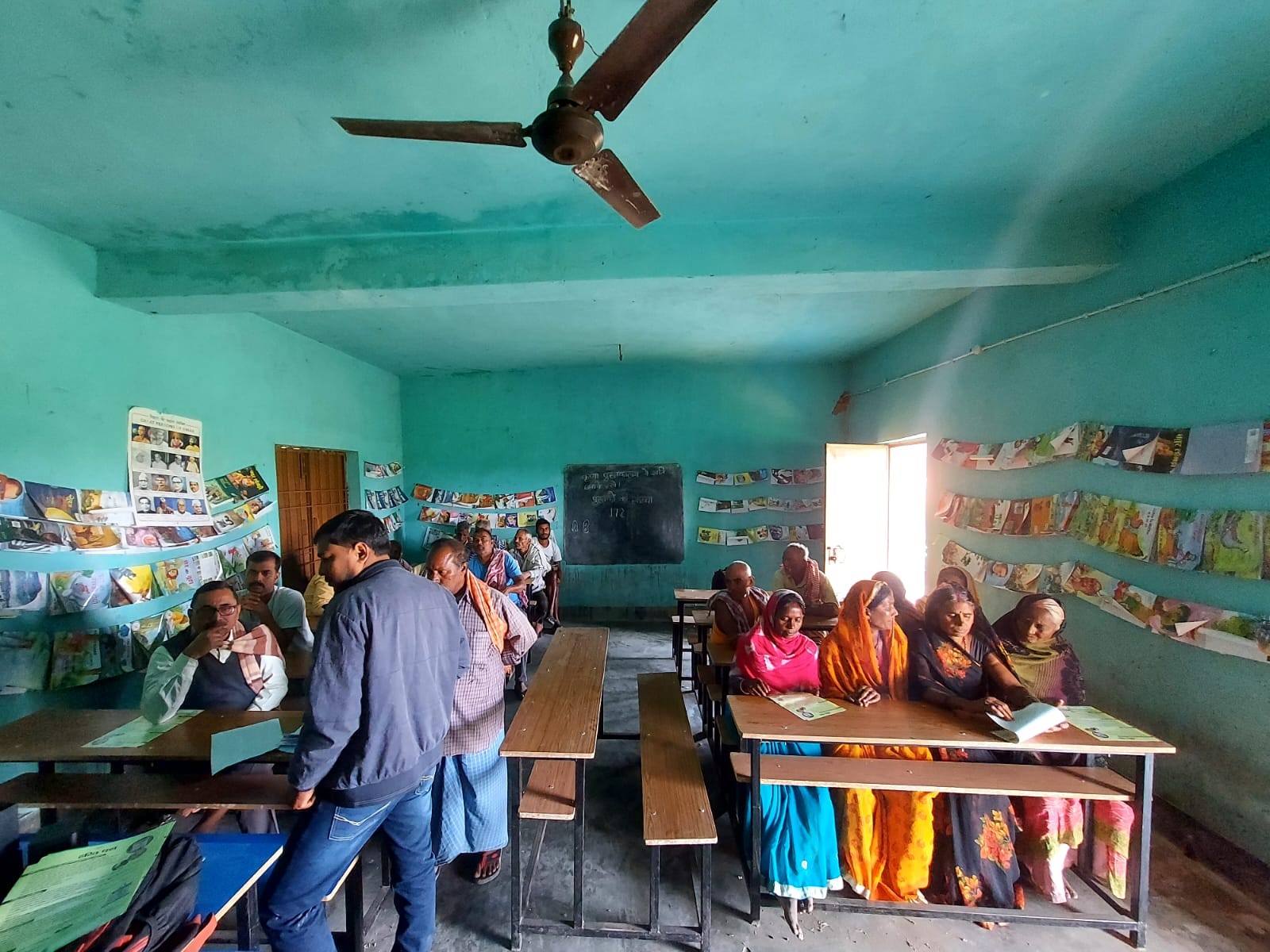
An artificial insemination technician conducts an awareness-raising meeting in a school. (Photo by TCI)
Earlier research conducted under the Zero-Hunger, Zero-Carbon Food Systems project identified two promising innovations—advanced artificial insemination with sex-sorted semen and Harit Dhara anti-methanogenic feed supplement—that offer farmers new pathways to improve productivity while contributing to climate resilience. Artificial insemination with sex-sorted semen uses advanced DNA-based sorting to increase the probability of female calves to around 90 percent, compared to 50 percent under conventional artificial insemination or natural breeding. More female calves mean higher milk production and fewer unproductive males. Harit Dhara is an anti-methanogenic feed supplement patented by the Indian Council of Agricultural Research, which has been shown to reduce methane emissions and improve cattle health. It has the potential to increase milk yields by 10–15 percent while reducing methane emissions from enteric fermentation by up to 20 percent.
Despite their promise, adoption of these technologies has been low. On average, only 16 percent of the breeding livestock in Bihar are bred using artificial insemination, while in some districts, this coverage is lower than 5 percent. Sex-sorted semen accounts for just 20 percent of these inseminations. Harit Dhara and other anti-methanogenic products are new and have only recently been used commercially. Very few farmers have heard of Harit Dhara, and even fewer have used it. Most households rely on home-made supplements, often due to cost constraints, low awareness, uncertain perceptions of benefits, and limited access to reliable products.
Raising awareness of climate-smart tech
In an attempt to address these gaps, TCI partnered with BAIF Development Research Foundation and Digital Green to create a large-scale, community-centered awareness campaign in 20 cattle development clusters (CDCs) spread across 14 districts in Bihar’s four agroecological zones. One artificial insemination technician from each CDC was trained to deliver the campaign. Eight clusters were subject to a campaign for sex-sorted semen, eight received a campaign about Harit Dhara, and four served as control clusters. The goal was simple yet ambitious: to ensure that every livestock-owning household in the intervention villages received accurate, accessible information about sex-sorted semen and Harit Dhara, and to determine whether this information would help farmers decide whether to adopt and purchase the product or not.
We presented the information to farmers during community meetings using short, easy-to-understand videos. The meetings were arranged by artificial insemination technicians and held at a village location convenient for most farmers. We used video to ensure that every attendee received the same, accurate information, independent of the technician’s knowledge and experience. Video also helped to overcome literacy barriers by presenting complex ideas visually and allowing the technicians to focus on guiding discussion rather than giving lengthy explanations of the technology. Additionally, the videos can potentially be reused by government agencies and NGOs to scale up the campaigns in the future.
The videos explained the importance of adopting modern technologies like sex-sorted semen and Harit Dhara in the face of increasing climate pressures on livestock rearing, while also emphasising how livestock management contributes to climate change. They also featured discussions on how each technology works, tips for successful adoption and use, costs and benefits, and the price at which the technologies would be made available.
In addition to watching the videos, attending farmers also received printed pamphlets summarizing key points. These served as take-home reference materials and allowed technicians to leave their contact information with farmers for future inquiries or purchases.
The participating artificial insemination technicians were already providing veterinary services in the villages. The familiarity between the technicians and the farmers enhanced attendance and enabled participation during sessions. Farmers felt comfortable asking questions, sharing concerns, and engaging at their own pace. However, reliance on technician networks also meant that villagers with no prior interaction with the technicians were less likely to attend the meetings, potentially reinforcing existing caste dynamics within the village.
Increased willingness to purchase
Our preliminary results show that 75 percent of farmers who attended a session on sex-sorted semen reported learning new information and had a higher stated willingness to adopt and pay for the product. Participants were 1.1 times more likely to purchase sex-sorted semen than nonparticipants. While this increase appears modest, it is noteworthy because the nonparticipant group already had a strong intent to purchase (they were willing to pay more than the offered price), suggesting even larger effects for other groups. Seventy percent of farmers who attended a session on Harit Dhara reported learning new information and had a higher willingness to adopt the feed supplement. Data on willingness to pay and purchasing decisions is still being processed. Taken together, these findings suggest that trusted, community-based information can meaningfully support the wider adoption of climate-smart livestock practices.
Sumedha Shukla is a senior associate researcher at TCI.
Milorad Plavsic is the manager for strategic initiatives at TCI.
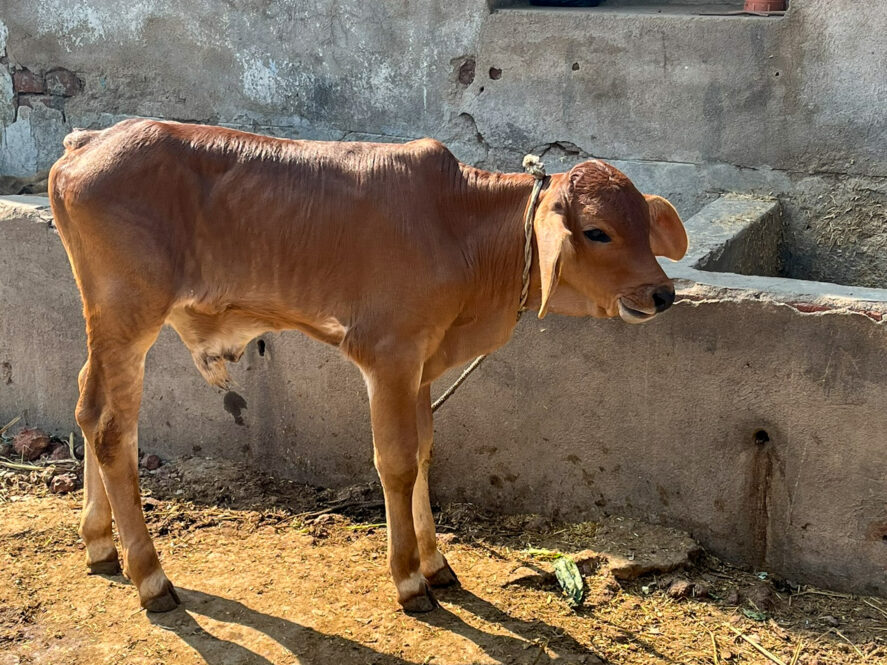
Featured image: Artificial insemination with sex-sorted semen increased the probability of female calves to around 90 percent, compared to 50 percent for conventional artificial insemination or natural breeding. (Photo by Kiera Crowley/TCI)