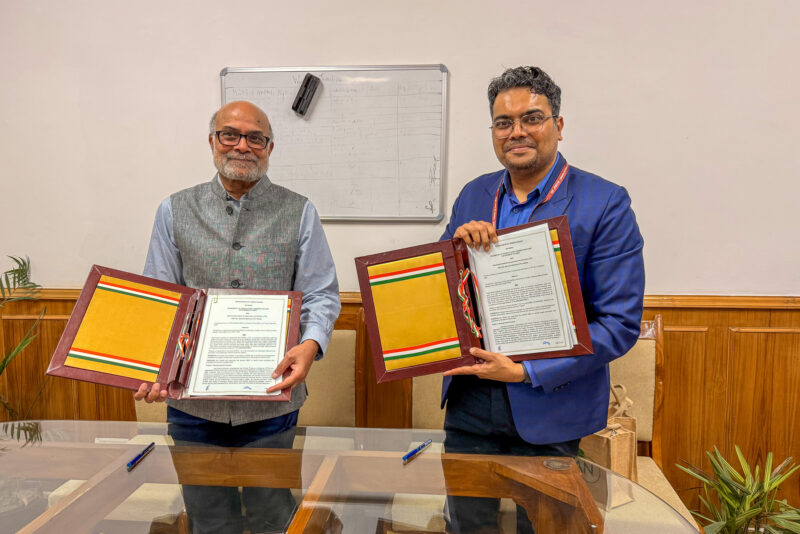
In Bihar, TCI Presents a Path for Productive, Climate-Smart Agriculture
The Tata-Cornell Institute for Agriculture and Nutrition (TCI) unveiled evidence for three pathways to make agriculture in Bihar more productive and environmentally sustainable at an event in Patna on October 16. The event was attended by government officials, researchers and members of the private sector.
At the roundtable discussion co-organized by the Centre for Sustainable Transition and Resilience, TCI researchers presented findings from the Institute’s project on Zero-Hunger, Zero-Carbon Food Systems, which aims to increase agricultural production in Bihar while reducing the associated greenhouse gas emissions. Project coordinator Milorad Plavsic introduced the project, which focuses on three interventions—community-based agrivoltaics, livestock breeding using advanced artificial insemination, and advanced crop management for rice production systems.
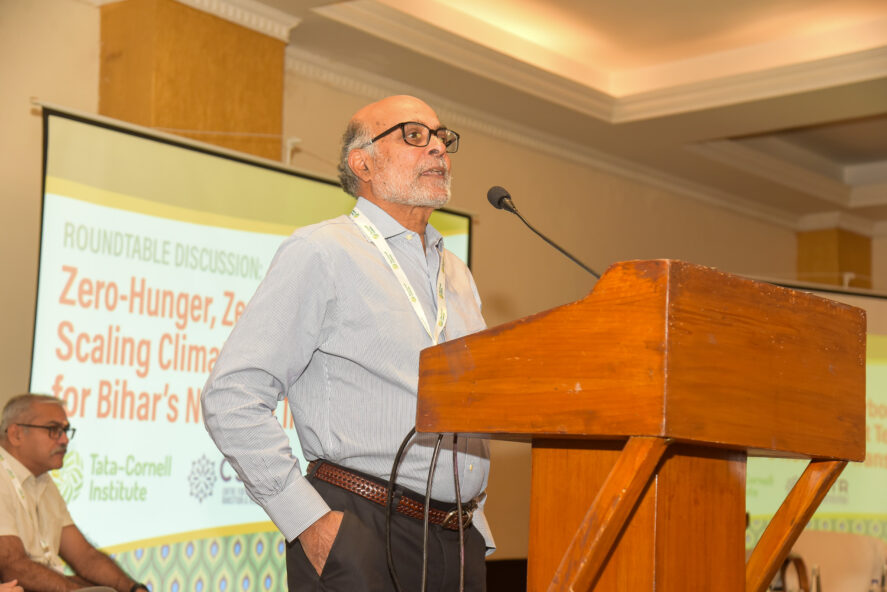
TCI Director Prabhu Pingali told those in attendance that achieving both Bihar’s development goals and its goals for reducing emissions will require different government ministries, as well as the private sector and research institutions, to work together.
“Increasing agricultural production and reducing greenhouse gas emissions are difficult challenges that require action from across government offices and different sectors of society,” Pingali said. “To secure the success and sustainability of zero-hunger, zero-carbon interventions and programs in Bihar, we must all ensure that our activities are aligned and supportive of each other.”
Additionally, Pankaj Kumar, principal secretary of Bihar’s Agriculture Department, shared his views related to dual goal of addressing environmental challenges and simultaneously increasing agricultural productivity.
“Agricultural production hinges on irrigation availability. Given groundwater challenges, solutions like rainwater harvesting and agrivoltaics are promising,” Kumar said.
Agrivoltaics for small farms
Harold van Es, a TCI faculty fellow and professor of soil and water management at Cornell University, presented insights from a muti-use agrivoltaics installation that TCI built with a group of farmers in Bihar’s Gaya Ji district. Agrivoltaics—the positioning of solar panels on active farmland—is typically used in large-scale applications to generate power for electrical grids. TCI adapted the concept to India’s agricultural system, which is dominated by small farms. The community-based model piloted by TCI deploys small solar arrays to power micro-irrigation, a flour mill, and possibly other future uses for six participating farmers, who jointly own and manage the associated infrastructure.
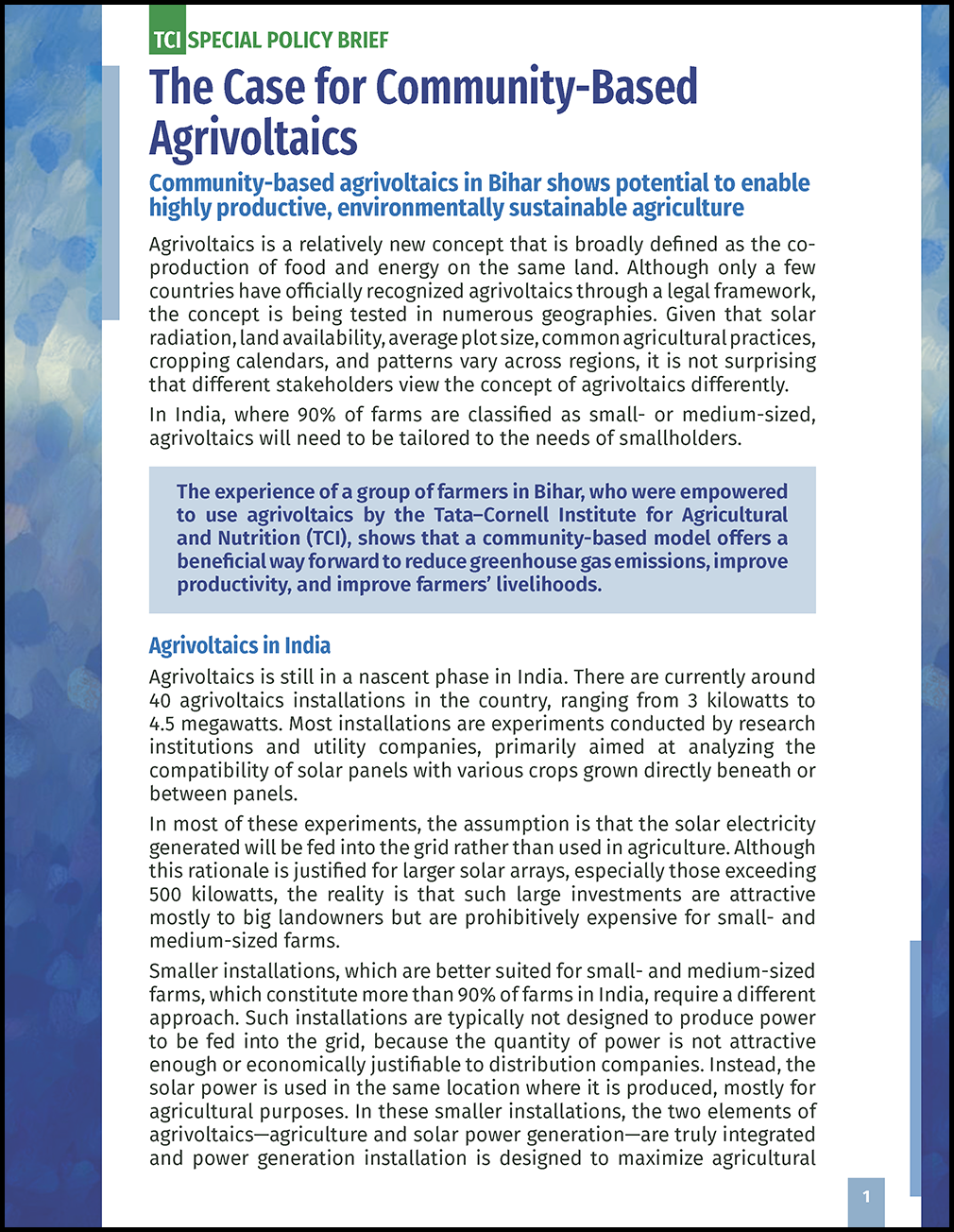
Download The Case for Community-Based Agrivoltaics to learn more about agrivoltaics in Bihar.
With the solar-powered drip and sprinkler irrigation, van Es said, the farmers can grow crops during dry seasons and minimize their water usage. Prior to the introduction of agrivoltaics, the farmers typically flooded their rice fields, which contributes to methane emissions and damages the soil, limiting productivity. With the new irrigation system, the farmers reported improved production.
“The photovoltaic solution we piloted in Gaya shows that small-scale agrivoltaics can address multiple community objectives and have a tremendous impact for smallholders,” van Es said. “We believe that this model can be successful in Bihar and across India, helping to reduce emissions while improving farmers’ livelihoods.”
The Gaya agrivoltaics installation was built by TCI in partnership with Preservation and Proliferation of Rural Resources and Nature (PRAN) and Jain Irrigation Systems.
Efficient livestock production
TCI senior associate researcher Sumedha Shukla presented the preliminary results of a TCI study on the promotion of advanced artificial insemination using sex-sorted semen for livestock breeding. With the rise of mechanized labor and social and legal challenges in the beef industry, male calves place an economic burden on dairy farmers in Bihar. By increasing the proportion of productive female animals among herds, advanced artificial insemination can improve productivity and thereby lower emissions. Previous TCI research shows that using advanced artificial insemination could lower the emissions associated with livestock production in the state by as much as 6.7 metric tons by 2050, while generating an estimated 207.5 million rupees in additional income for farmers.
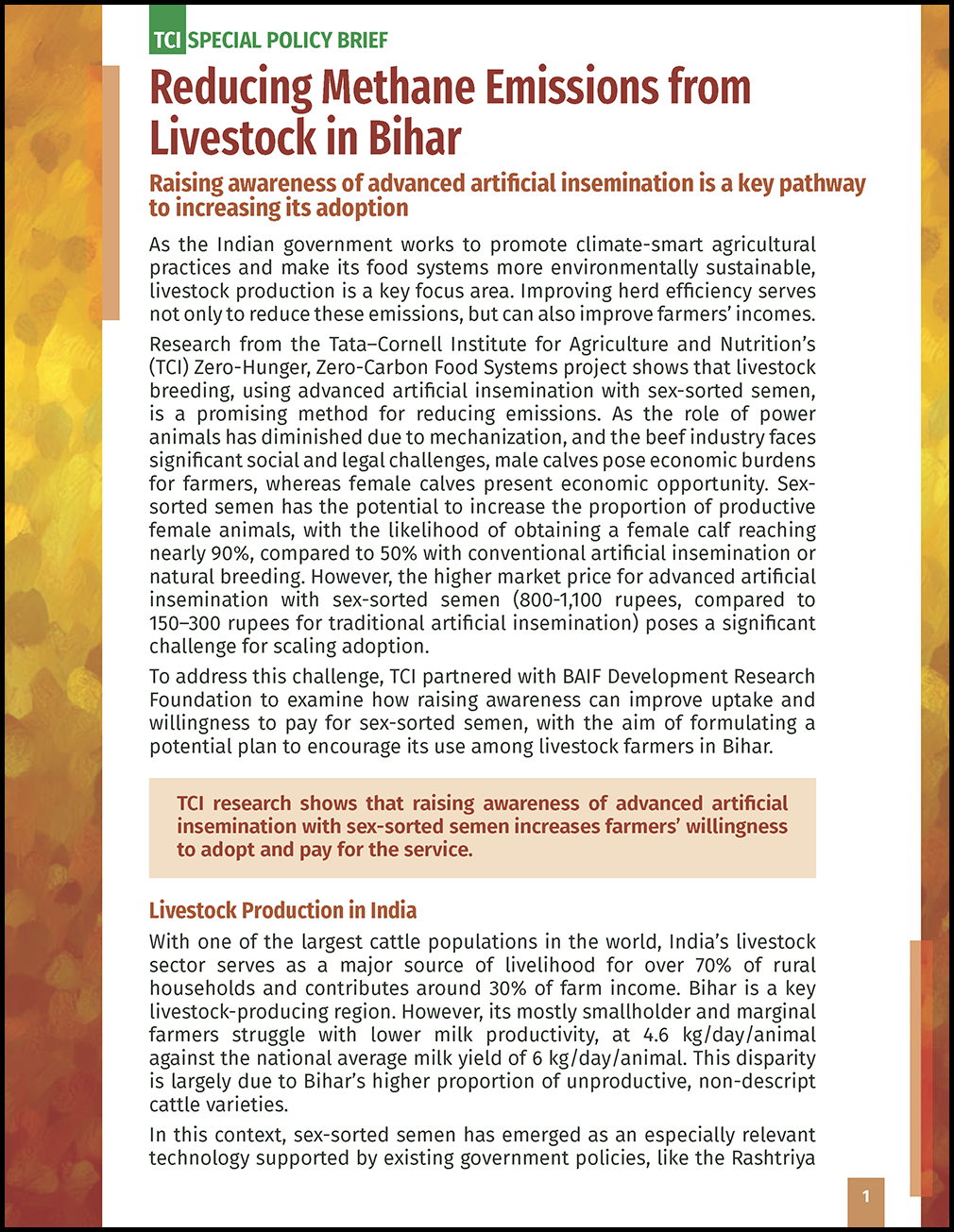
Download Reducing Methane Emissions from Livestock in Bihar to learn more about TCI’s research on advanced artificial insemination.
Widescale adoption of advanced artificial insemination in India has been stymied by high costs, Shukla said. To address that challenge, TCI partnered with BAIF Development Research Foundation to administer a campaign to raise awareness of advanced artificial insemination and assess how it affected farmers’ willingness to adopt and pay for the service. They found that willingness to adopt the service increased by about 27% after the campaign, while willingness to pay increased by about 7%.
“Advanced artificial insemination with sex-sorted semen holds enormous potential to increase milk production and decrease emissions if the barriers to adoption can be overcome,” Shukla said. “Our research shows that raising awareness is a promising pathway for achieving that goal.”
In addition to raising awareness, Shukla said that TCI research also showed that the adoption of advanced artificial insemination can be encouraged by engendering trust in the agencies administering the service, in addition to building out cold storage and other infrastructure to ensure reliable and timely delivery.
Improving rice productivity
Andrew McDonald, a TCI faculty fellow and associate professor of soil and crop science at Cornell University, presented his research on rice production systems in eastern India, which focuses on tailoring crop management approaches to local environments in order to boost productivity.
“Rice is a vitally important crop in Bihar,” McDonald said. “Our research shows that efforts to improve the productivity of Bihar’s rice farms can go hand in hand with efforts to reduce greenhouse gas emissions.”
Download Strategies for Climate Action and Sustaining Rice Productivity in Eastern India to learn more about TCI research on rice production systems.
McDonald said that the excessive usage of nitrogen fertilizer—which is government-subsidized in India—contributes to high nitrous oxide emissions from rice farming. His research explored the nitrogen use efficiency (the amount of rice produced per unit of nitrogen) of farms across Bihar and eastern India. About 50% of Bihar farmers could decrease fertilizer usage without sacrificing yields, he said, though farmers in northern Bihar would benefit from using more fertilizer. According to McDonald, precision nitrogen fertilizer recommendations, in tandem with interventions to improve irrigation, would significantly boost productivity and profitability while reducing emissions.
McDonald also discussed the importance of reducing methane emissions from rice production, which, mostly because of soil flooding, contributes roughly 50% of all greenhouse gas emissions from global croplands. Researchers often presume that most of the land in Bihar dedicated to rice production is continuously flooded, but emerging research shows a more complicated hydrologic picture in the region, he said, which affects both emissions estimates and the proposed mitigation interventions. McDonald’s research suggests that mitigation efforts should focus on identifying Bihar’s “emissions hotspots” and matching them with the technologies best suited to local conditions. One such technology is alternate wetting and drying, a controlled irrigation technology that reduces water consumption.
Featured image: TCI Director Prabhu Pingali spoke at the beginning of the roundtable discussion of zero-hunger, zero-carbon food systems in Patna, Bihar. (Photo by SSV Events)