Researchers and Policymakers Talk Future of Climate-Smart Agriculture
India faces a difficult challenge in the near future: producing enough food to feed its growing population while reducing the stresses agriculture puts on the environment. At a policy dialogue organized by the Tata-Cornell Institute for Agriculture and Nutrition (TCI) on Monday, February 16, researchers, government officials and key stakeholders from private industry and civil society discussed ways to overcome this challenge based on research conducted by TCI in Bihar and Chhattisgarh.
While recognizing the complexity of achieving increased production without increased environmental harm, participants at the event agreed that the goal is within reach. Progress toward the adoption of policies incentivizing climate-smart practices has been made, albeit at a slow pace. The availability of near real-time data and modeling technologies has opened opportunities for targeted interventions, the participants agreed, while dismissing so-called “silver bullet” solutions that have failed to deliver results, such as fertilizer subsidies.
“The policymaking process sometimes involves tradeoffs, and when the tradeoffs are inadequately addressed, policies undermine each other,” TCI Director Prabhu Pingali said. “Our work in Bihar and Chhattisgarh shows that there are opportunities to overcome the tradeoffs in agriculture through increased input efficiencies in the rice and livestock sectors, system-wide crop diversification and synergies between the food, water and energy sectors.”
“The policymaking process sometimes involves tradeoffs, and when the tradeoffs are inadequately addressed, policies undermine each other,” TCI Director Prabhu Pingali said. “Our work in Bihar and Chhattisgarh shows that there are opportunities to overcome the tradeoffs in agriculture through increased input efficiencies in the rice and livestock sectors, system-wide crop diversification and synergies between the food, water and energy sectors.”
Himanshu Pathak, director general of the International Crops Research Institute for the Semi-Arid Tropics (ICRISAT), delivered the keynote address at the event. He shared his experience with sustainable rice intensification, emphasizing the importance of targeted advisory services and interventions. “There are areas in India where it is impossible to reduce greenhouse gas emissions from rice by modifying irrigation practices, areas where it is possible but very difficult, and some areas where that can be done,” he said.
Pathak also said that conservation agriculture has the potential to reduce emissions only if properly and completely implemented. He warned that it can lead to an increase in emissions if production practice components are only partially implemented.
At the event, TCI researchers presented the Institute’s research on three interventions designed to increase agricultural productivity while reducing greenhouse gas emissions and other environmental impacts associated with farming.
TCI Assistant Director Mathew Abraham discussed TCI’s work on crop diversification in Chhattisgarh. In the state, the Institute’s researchers are studying how diversification can be encouraged through knowledge sharing with farmers, providing market support for different crops, and promoting community-based solar irrigation systems.
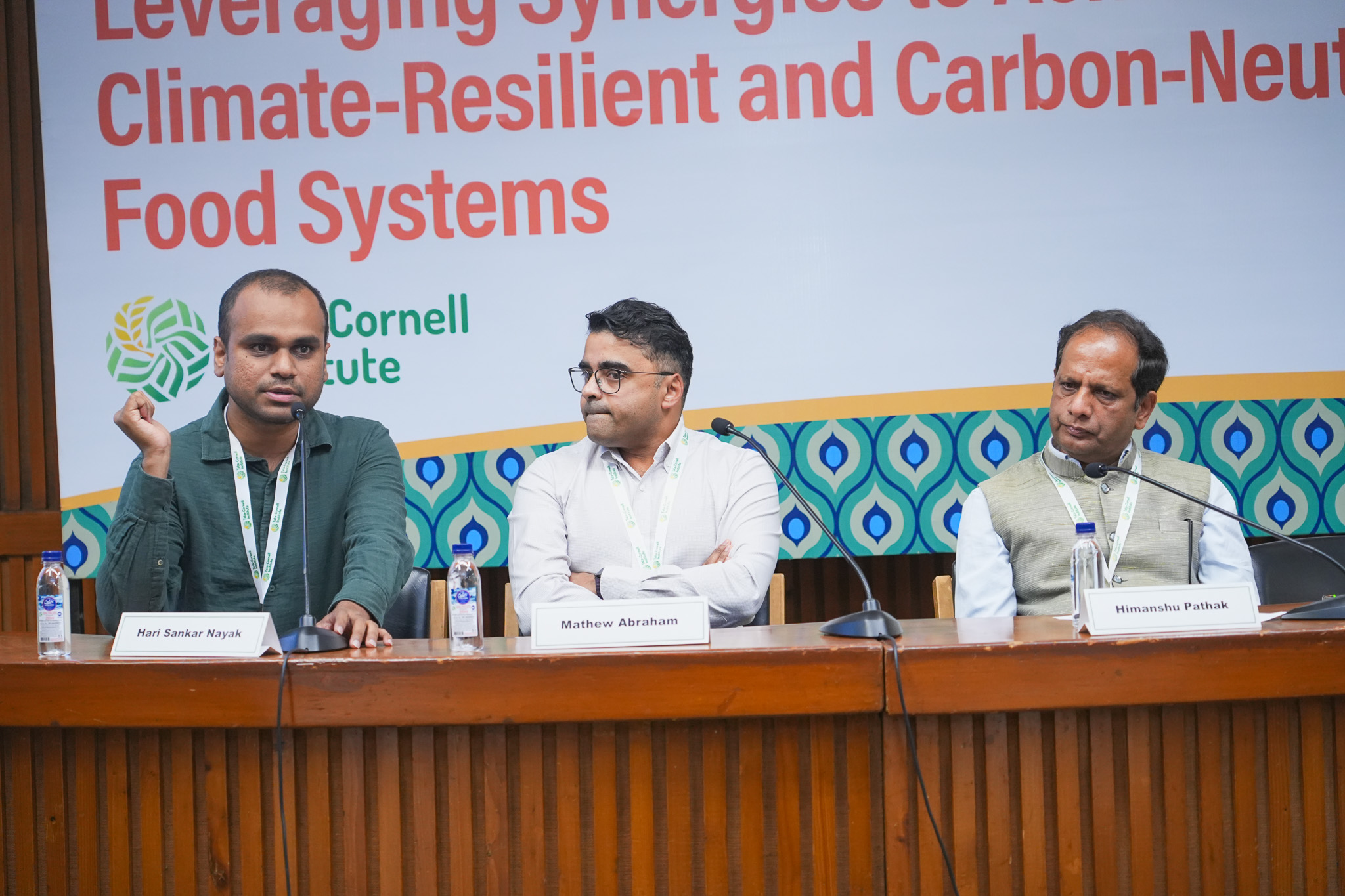
Hari Nayak, Mathew Abraham and Himanshu Pathak discussed crop diversification during a panel discussion. (Photo by TCI)
“While Chhattisgarh is making significant efforts to promote crop diversification away from rice, some state policy instruments, such as minimum support prices and a lack of market infrastructure, drive farmers to increase rice production,” Abraham said.
The Aga Khan Foundation’s Tinni Sawhney shared her experience in crop diversification from Bihar, stating that the major levers for diversification lie in better market connectivity for vegetables and other perishable crops, as well as improved soil health from growing diverse crops. Tamali Kundu, a representative from PRADAN, said that crop diversification can also be driven by market assurances and data-driven zoning.
Hari Nayak, a scholar from the International Rice Research Institute, shared his research showing that the heterogeneity of ecological areas and agricultural practices within Bihar requires different emissions mitigation strategies, echoing Pathak’s remarks on targeted interventions.
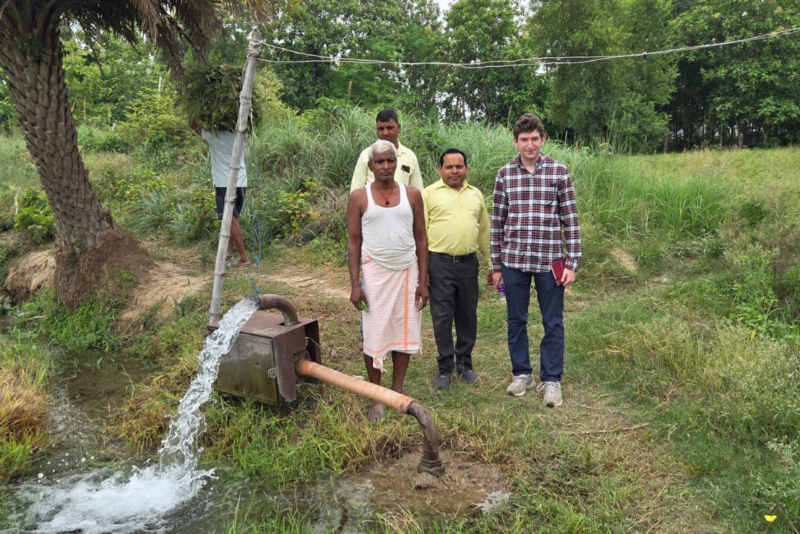
Milorad Plavsic, TCI’s manager of strategic initiatives, discussed the community-based agrivoltaics model piloted by the Institute in Bihar. The model uses solar panels located on agricultural land to power irrigation systems and a grain mill. “Our data indicate that community agrivoltaics can lead to crop diversification, resulting in lower water use and greenhouse gas emissions while increasing household income,” he said.
Plavsic noted that there is still a long way before the community-based agrivoltaics concept reaches its full potential, as only 16–60% of the energy produced by the solar array is currently being used, exposing missed opportunities to further advance the rural economy.
Shubhashree Chakraborty of the National Solar Energy Federation of India and Sumit Anand of GIZ presented their institutions’ work on agrivoltaics, showing that while still a relatively new technology, India has recognized its transformative potential.
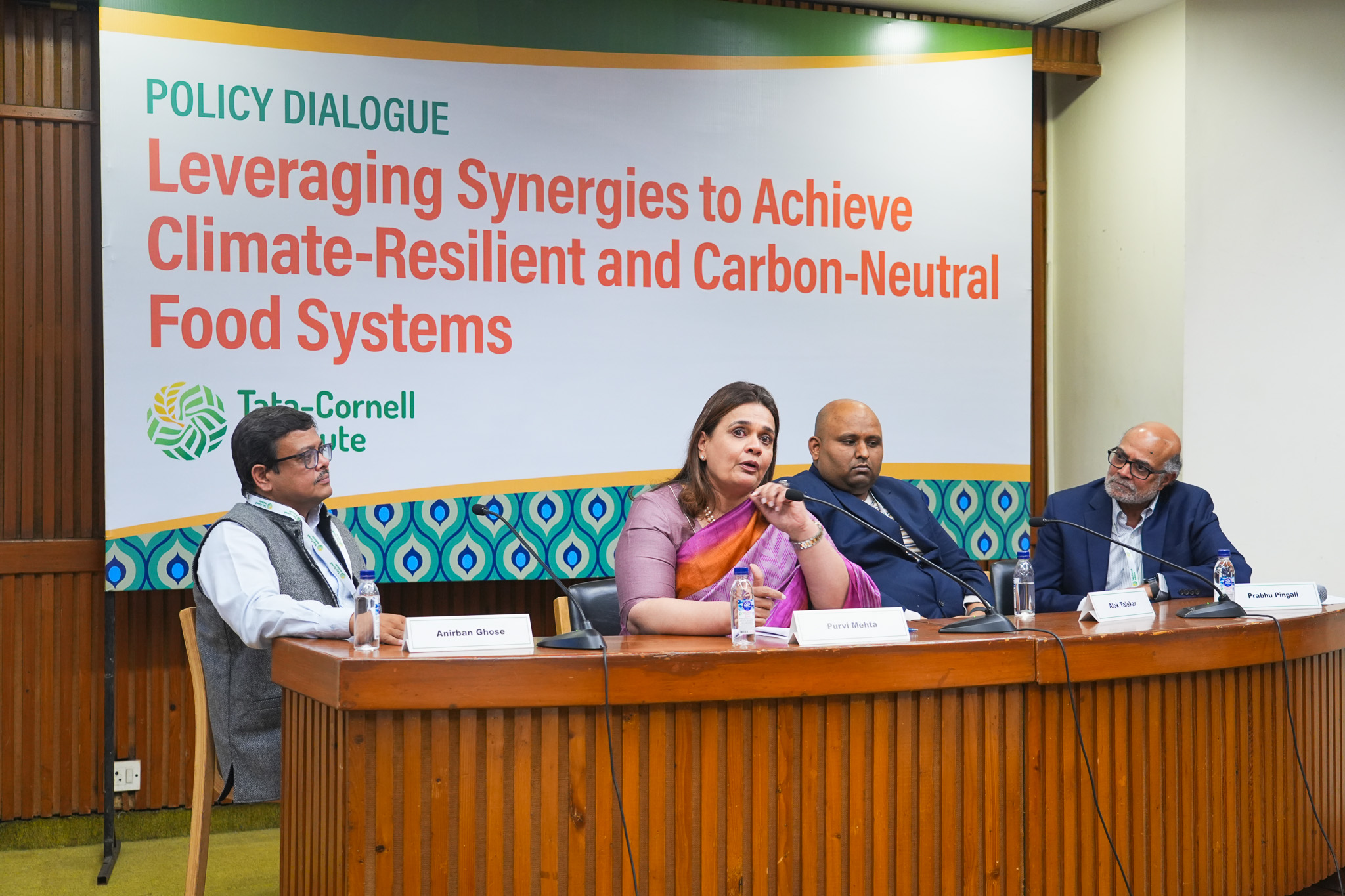
Anirban Ghose, Purvi Mehta, and Alok Talekar discussed the importance of coordinating government policies in support of climate-smart agriculture. (Photo by TCI)
Bhupendra Phondba, a senior researcher from India’s National Dairy Development Board, discussed multiple ways to reduce emissions from the livestock sector, such as intervention feeding, genetic improvement and manure management.
The event also included a panel discussion on the convergence of central and state government policies for climate-smart agriculture, chaired by Pingali. Panelists included Cornell University adjunct professor Purvi Mehta, Transform Rural India’s Anirban Ghose and Google’s Alok Talekar. Ghose stressed that convergence is needed on all levels—nationally, in individual districts, and in local communities. Mehta proposed an accountability framework, inspired by a similar concept in the private sector. Talekar said that the unprecedented level of data granularity should support the institutions in finding better, more efficient and targeted solutions. He also remarked that convergence is not a single point in time and the goal in itself, but rather an ongoing process that enables progress.
Mahendra Dev, chairman of the Economic Advisory Council to the Prime Minister of India, provided the closing address, reiterating the importance of aiming for the eradication of hunger and net-zero emissions simultaneously.
“Policy convergence is already happening, yet very slowly,” he said. “As we know, agriculture and nutrition, which used to be studied in isolation in the past, have come closer and new interventions in agriculture are designed to have a positive impact on nutrition.”
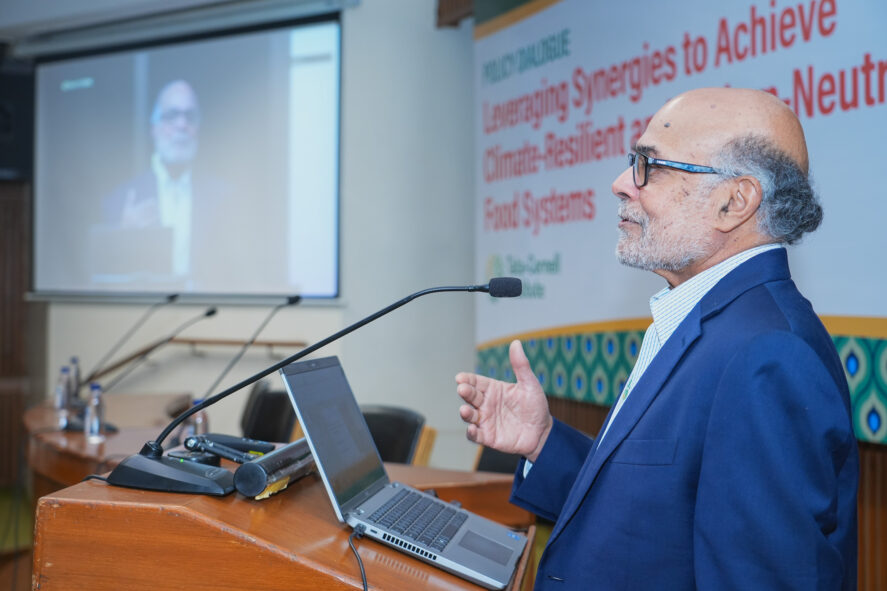
Featured image: TCI Director Prabhu Pingali addresses attendees at the policy dialogue in Delhi on February 16, 2026. (Photo by TCI)