2025–26 in Review: Climate Change & Sustainable Agriculture

This article presents a review of TCI research from the 2025–26 academic year related to climate change and sustainable agriculture. For more TCI research, download the 2025–26 annual report.
Cultivating carbon-neutral, highly productive food systems
Two of the thorniest challenges facing India today are climate change and persistent hunger and malnutrition. The shift to a green economy could hamper efforts to grow more food, while boosting production threatens to increase greenhouse gas emissions. Similarly, failing to curb climate change and adapt to shifting weather patterns puts agricultural production at risk.
TCI’s project on “Zero-Hunger, Zero-Carbon Food Systems” aims to identify, study, and promote synergistic solutions that reduce emissions while improving agricultural productivity and increasing the resiliency of India’s food systems in the face of climate change. TCI researchers, working with partner organizations on the ground, have identified several potential pathways to build a climate-smart agricultural sector.
Shining a light on agrivoltaics
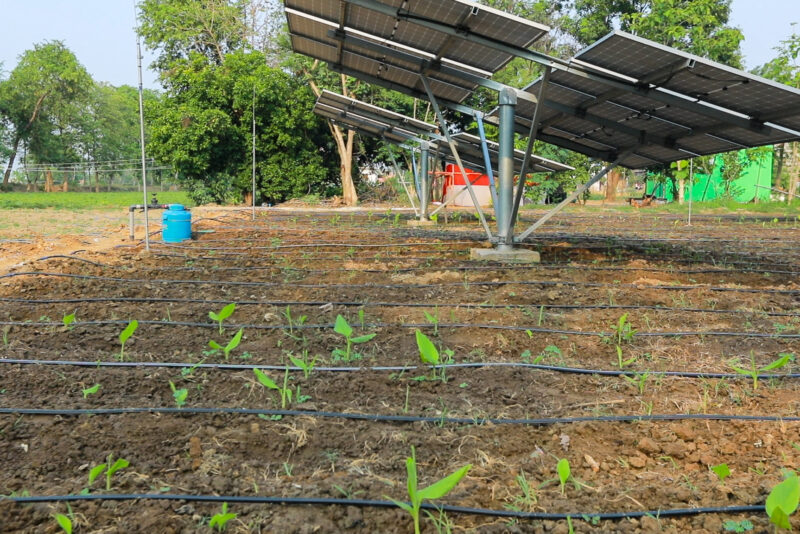
In the summer of 2025, TCI and Preservation and Proliferation of Rural Resources and Nature (PRAN), along with Jain Irrigation Systems, completed construction of a pilot agrivoltaics installation in Bihar’s Gaya Ji district.
Agrivoltaics combines agriculture and solar power generation to prevent the competition of food and energy production for land. Although traditional agrivoltaics emphasizes large-scale power generation for the electrical grid, TCI’s test site was engineered with smallholder needs and capacities as its focus. In TCI’s community-based model, six farmers jointly own and manage a 20-kilowatt solar array, which produces electricity for micro-irrigation systems and a grain mill.
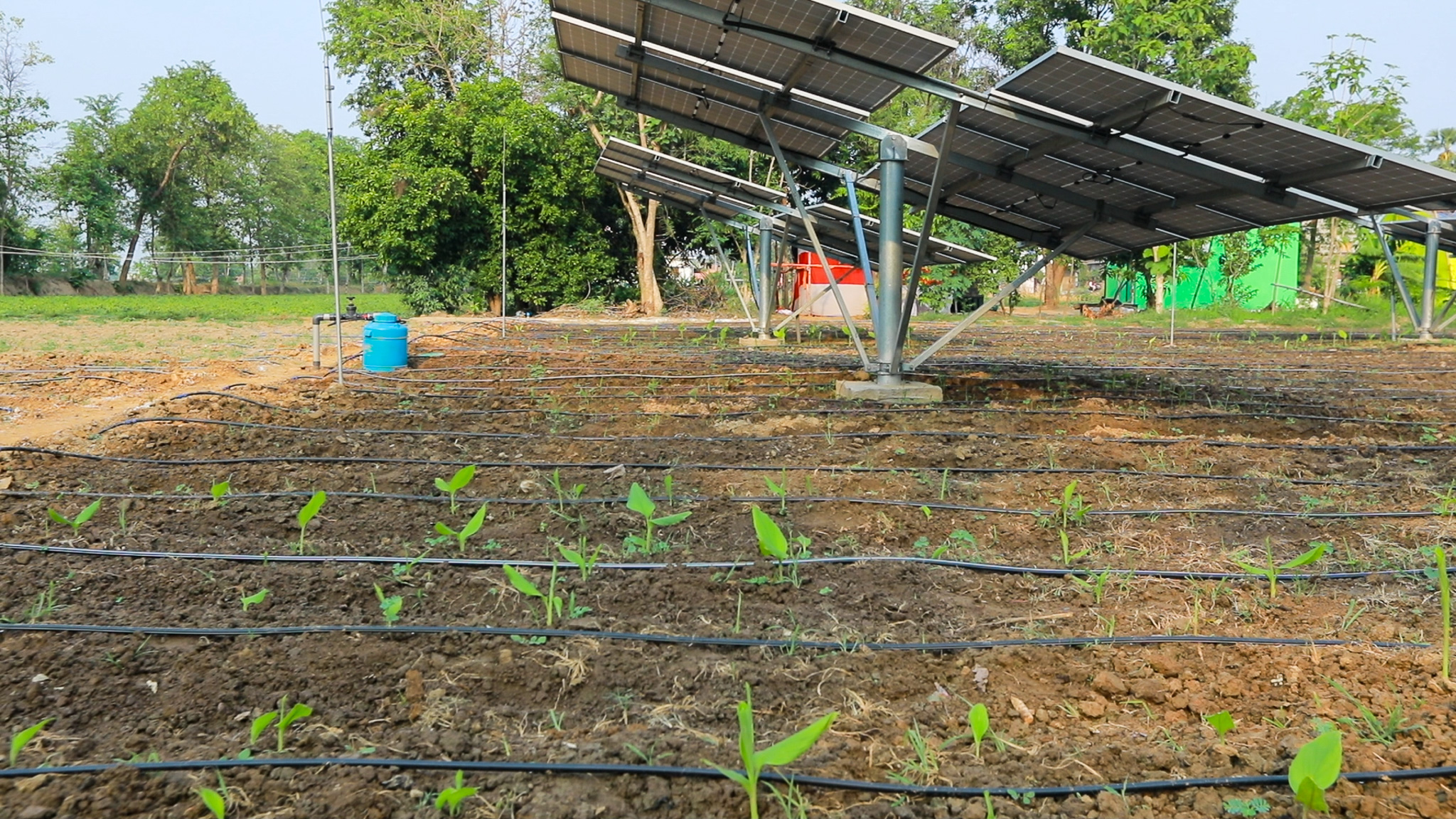
Crops grow amid solar panels at the agrivoltaics installation TCI built in Bihar. (Photo by TCI)
Access to reliable and affordable irrigation allowed the farmers to begin growing crops during dry seasons. The farmers also decided to grow a more diverse sets of crops, including a relay cropping system (mung bean–okra–banana) on the same field. The drip and sprinkler systems also reduced the amount of water needed for cultivation and improved soil conditions. Yields and crop income increased as a result.
The farmers can also generate income by charging for grain mill services. Additional uses for excess energy generated, such as food preparation appliances and refrigeration, are also possible.
Efficient livestock production
Livestock production is one of the largest sources of agricultural emissions in India. TCI research shows that increasing the proportion of productive female animals in herds. through the use of enhanced artificial insemination with sex-sorted semen, can lower the emissions associated with livestock production in Bihar by as much as 6.7 metric tons by 2050, while also generating an estimated 207.5 million rupees in additional income for farmers.
However, widespread adoption of advanced artificial insemination in India has been stymied by high costs and low awareness. In Bihar, TCI partnered with BAIF Development Research Foundation to administer a campaign to raise awareness of advanced artificial insemination and assess how it affected farmers’ willingness to adopt and pay for the service. The researchers found that willingness to adopt the service increased by about 27 percent after the campaign, while willingness to pay increased by about 7 percent.
Improving rice productivity
As part of the project, TCI supported TCI Faculty Fellow Andrew McDonald’s research, which focuses on boosting productivity by tailoring crop management approaches to local environments.
Excessive use of nitrogen fertilizer, which is subsidized by the Indian government, contributes to high nitrous oxide emissions from rice farming. McDonald’s research shows that about 50 percent of Bihar farmers could decrease fertilizer usage without sacrificing yields, while some in northern Bihar could increase yields by using more fertilizer. Such precision nitrogen fertilizer recommendations, in tandem with interventions to improve irrigation, could significantly boost productivity and profitability while reducing emissions.
In addition to nitrous oxide, rice production also contributes to climate change through methane emissions caused by soil flooding practices. Many presume that most rice production in Bihar relies on continuous flooding, but emerging research shows a more complicated hydrologic picture, which affects both emissions estimates and potential mitigation interventions. McDonald’s research suggests that mitigation efforts should focus on identifying Bihar’s “emissions hotspots” and matching them with the technologies best suited to local conditions. One such technology is alternate wetting and drying, which uses controlled irrigation to reduce water consumption.
Promoting climate-smart farm practices
Using its research, TCI is promoting agrivoltaics, advanced artificial insemination, and improved rice management systems in Bihar and throughout India. In fall 2025, TCI co-organized a roundtable discussion in Patna, Bihar, during which researchers presented their findings to government officials, private sector actors, and other researchers. In early 2026, TCI held a policy dialogue in Delhi to present its research and discuss ways to implement its findings into government policies.
Taken together, the research conducted under this project highlights clear steps India can take to ensure that its future food systems meet the country’s nutritional needs without contributing to climate change.
Supporting climate-resilient and nutrition-sensitive food systems
The heavy dependence on paddy cultivation in India’s rice bowl state, Chhattisgarh, highlights several environmental and nutritional concerns. Reliance on a water-intensive crop like paddy contributes to groundwater depletion, methane emissions, soil health depletion, and susceptibility to climate shocks, especially in rainfed regions. A rice-heavy diet increases the risk of malnutrition and noncommunicable diseases, compared to traditional crops like millets and pulses, which are richer in iron, fiber, and protein.
To mitigate these interlinked environmental and nutritional challenges, TCI is assessing different pathways that can potentially facilitate the transition to a more diversified cropping system. In coordination with Professional Assistance for Development Action (PRADAN), TCI implemented a field trial to assess three climate-smart interventions: knowledge sharing, market support, and irrigation enhancement.

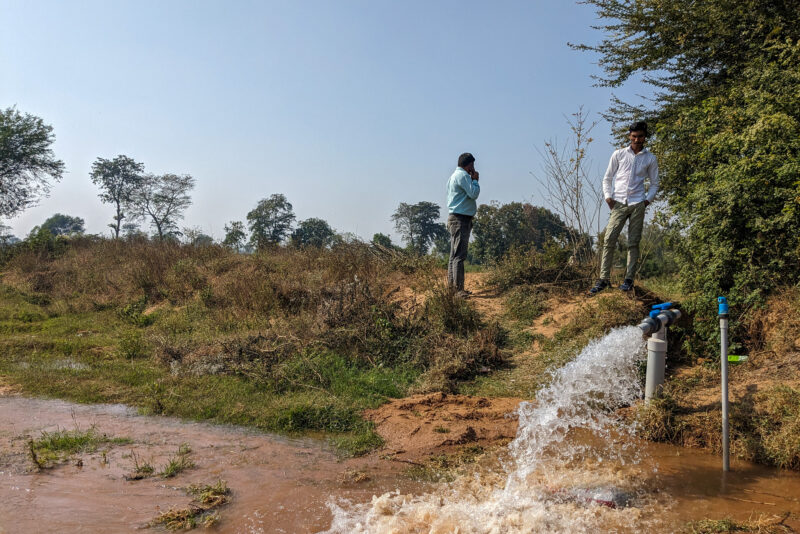
TCI and PRADAN built solar-powered lift irrigation systems for farmers in Chhattisgarh to promote crop diversification. (Photo by TCI)
The first intervention pathway consisted of a series of workshops that provided farmers with information about climate change, including its origins, impacts, and broad mitigation efforts. Training on cultivation techniques and strategies for crops like paddy, millets, oilseeds, and pulses, with an emphasis on climate-resilient processes and scientific methods, was also provided.
The second intervention was designed to evaluate whether facilitating access to agricultural inputs and strengthening market linkages can support the adoption of non-paddy crops. Farmers received crop input kits containing seeds, organic manures, and crop medicines at a nominal cost. Further provisions for postharvest value addition were made through the installation of village-level pulse and oilseed processing units.
The third intervention was aimed at understanding whether improving irrigation access would enable farmers to diversify into alternative crops. TCI and PRADAN built solar lift irrigation infrastructure and farm ponds, in addition to establishing community-based water user groups.
TCI researchers are monitoring the impact of these interventions to gain actionable insights on transitions in the agricultural system. The findings from this research can help to inform policies supporting a shift to a more nutrition-sensitive, climate-conscious food system.
Feature image: Livestock are one of the leading agricultural sources of greenhouse gas emissions. (Photo
by TCI)