Food Packaging and the Food Loss and Waste Challenge
This blog post is the first in a series exploring the connection between food packaging and food loss and waste within sustainable food systems, focusing on nutritious, perishable foods. Throughout this series, FLW will be defined as a reduction in the quantity or quality of the edible portion of food intended for human consumption when food is redirected to non-food uses or when there is a decrease in the nutritional value, food safety, or other quality aspect from the time food is ready for harvest or slaughter to consumption.
Globally, packaging generates 40% of the 353 million tons of plastic waste created each year. Food packaging, commonly made of plastic, highlights a complex issue: while contributing to environmental problems, it is also an important tool for minimizing food loss and waste.
As my coauthor, Prabhu Pingali, and I demonstrate in our new book, “Wasted Potential: Tackling Food Loss and Waste Across Transforming Food Systems,” in order develop and implement sustainable food packaging solutions, it is essential to assess the potential for different types of food packaging to reduce food loss and waste (FLW) within the context of other packaging tradeoffs.
The transformation of food systems
As food systems modernize, the distance between production and consumption increases to meet the needs of growing urban populations. These longer food value chains have extended transit times from harvest to consumer and necessitate greater handling by intermediaries. At the same time, food systems transformations are marked by a shift in consumer demand towards diversified diets that include nutritious, perishable foods with convenient packaging.
Food loss and waste increase at each value chain stage due to time, temperature, handling and varying stakeholder food quality standards. Waste management, including discarded edible food, inedible portions and packaging, extends from farm to household. Region-specific strategies are necessary, but sustainable management is constrained by technical, organizational, financial and political barriers.
Urbanization concentrates food and packaging, leading to waste management challenges stemming from increased per-capita waste and population density. In transitional food systems that have both traditional and modern value chains, such as in India, infrastructure limitations compound these challenges, hindering both food distribution and waste disposal in densely populated urban areas.
Food packaging solutions
Despite the potential of packaging solutions to minimize FLW in developing countries, the proliferation in food packaging, particularly plastic, has raised significant environmental and health concerns within sustainable food systems. This has positioned food packaging as a key sustainability issue, requiring careful consideration of packaging choices, material use and end-of-life management.
From harvest to consumption, food packaging plays a vital role in the food value chain. It provides three key value-added functions: containment and protection, facilitated handling and transport, and information dissemination. These functions are intrinsically linked to FLW reduction by maintaining food quality, safety and consumer appeal, in addition to optimizing food movement and empowering value chain actors and consumers with information.
National efforts to regulate sustainable food packaging are gaining momentum. A recent review identified 15 countries and two regional unions (the European Union and the Gulf Cooperation Council) with established policies. These regulations address a variety of concerns, including bans on single-use plastics, and mandated recyclability. Fundamentally, these policies are based on either extended producer responsibility or a circular economy framework.
Under extended producer responsibility, producers are obligated to manage the post-consumer phase of their products, including packaging. This involves considering material choices, developing recycling infrastructure, improving energy efficiency and minimizing harmful compounds. Notably, evidence suggests that extended producer responsibility policies tend to influence the amount of packaging used more than material composition.
Policies based on circular economy frameworks aim to minimize the environmental impact of food packaging through intentional system design. Circular approaches to plastic food packaging management, in contrast to the linear “take-make-waste” model of resource extraction and disposal, prioritize recycling through chemical, biological and thermal processes to regenerate input materials.
Balancing material solutions: Function and end-of-life disposal
The wide range of packaging applications poses a significant challenge to the design of sustainable food packaging systems aimed at reducing FLW. Packaging is generally divided into two categories: bulk and consumer. Bulk packaging is used throughout all food value chains to move food from production to retail, regardless of whether items are sold loose or in consumer packaging. Consumer packaging, in contrast, includes retail units where food is sold pre-packaged or for self-selection.
The next three blog posts in this series will examine specific packaging types, focusing on the critical considerations for identifying sustainability trade-offs. This includes the potential benefits of packaging, such as FLW reduction and convenience, as well as challenges with end-of-life disposal and waste management. Real-world examples from TCI’s work in India will provide practical insights.
Jocelyn Boiteau is a TCI alumna and director of nutrition impact and innovation at Food Systems for the Future.
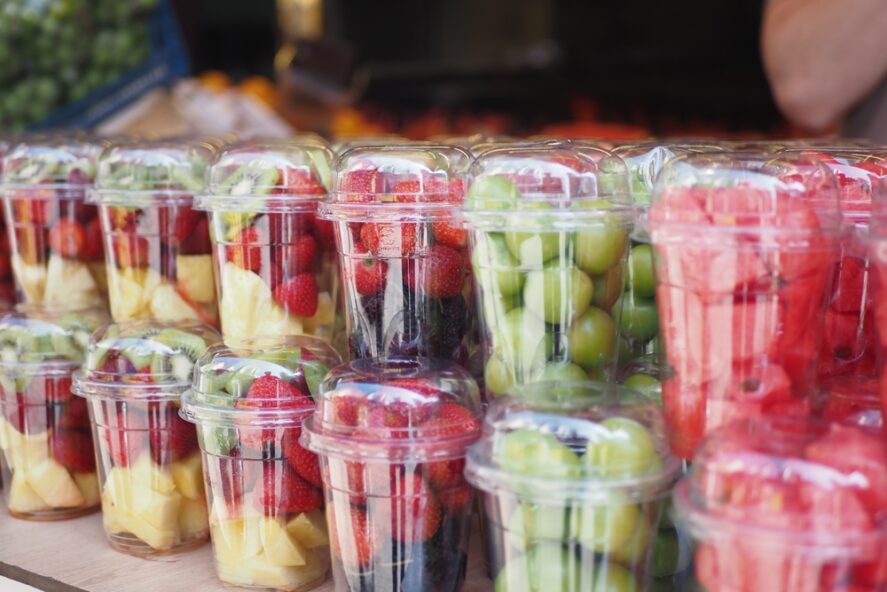
Featured image: Plastic packaging can reduce food loss along value chains, but at the cost of increased plastic waste. (Photo by Towfiqu Ahamed Barbhuiya/Shutterstock)