Is the Formation of Farmer Producer Organizations from Self-Help Groups the Key to Women’s Agricultural Development?
Self-help groups (SHGs) have been a source of women’s empowerment and livelihood development across India. SHGs are a small collection of individuals who meet and work together to encourage savings, provide microcredit, and promote entrepreneurship amongst members. However, the literature shows that for India’s female farmers, access to microcredit often falls short in providing the resources and support they need for agricultural development. Since 76% of India’s working women are farmers, finding an alternative model that better addresses the challenges that rural female farmers face could have widespread implications for women’s empowerment and development.
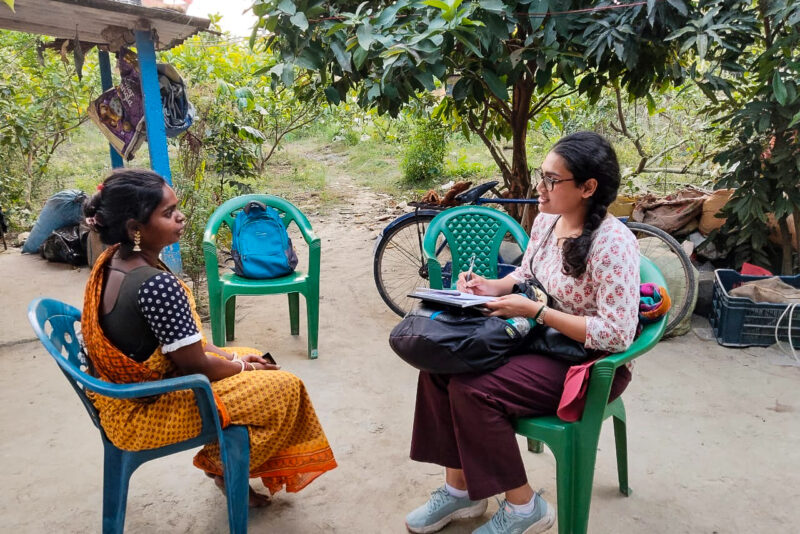
Over the past two years, TCI researchers conducted interviews and focus groups across India for a report on India’s farmer producer organizations (FPOs), with a special focus on women-led FPOs. We developed case studies for six women-led FPOs (see table below) to explore whether FPOs can offer an alternative form of collective action to address SHG shortcomings. Like SHGs, FPOs draw on collective action and pooled resources to promote development. But, instead of small loans and savings, the organization’s focus is oriented towards overcoming market failures specific to smallholder farmers by engaging markets at greater economies of scale.
|
FPO |
Location |
Year formed |
Share-holders |
Paid-up capital |
Directors |
Women directors |
Cluster-based business organization |
|
Damini Women’s Farmer Producer Company Limited |
Wardha, Maharashtra |
2019 |
500 |
500,000 |
5 |
4 |
Bajaj Foundation |
|
Gattasilli Farmer Producer Company Limited |
Dhamtari, Chhattisgarh |
2021 |
381 |
800,000 |
5 |
5 |
Pradan |
|
Mahila Umang Producer Company Limited |
Almora, Uttarakhand |
2009 |
130 |
215,900 |
7 |
7 |
Pan Himalaya Grassroots Development Foundation |
|
Sanghamitra Mahila Producer Company Limited |
Chirang, Assam |
2020 |
1,752 |
358,800 |
5 |
5 |
Seven Sisters Development Assistance (SeSTA) |
|
Sevaiyoor Traditional Crop Producer Company Limited |
Sevaiyoor, Tamil Nadu |
2015 |
1,488 |
2,500,000 |
5 |
3 |
The Covenant Center for Development (CCD) |
|
Banke Bazar Mahila Vikas Producer Company Limited |
Banke Bazar, Bihar |
2022 |
1,000 |
580,000 |
5 |
5 |
Sarva Seva Samity Sanstha (4S) |
Drawing on the results of these cases, we argue that:
- FPOs can address many of the challenges female farmers face in their agricultural development.
- Mature SHGs have the critical capabilities necessary for forming and running an FPO, but require some targeted support from civil society organizations to access markets.
In other words, mature SHGs serving female farmers interested in furthering their agricultural development are strong candidates to form FPOs.
Self-help groups provide empowerment, but not agricultural development
Female farmers face challenges with increasing agricultural production, productive asset management and commercialization. Some of these challenges stem from a lack of productive land ownership and inexperience and discrimination when accessing markets, which are historically male-dominated spaces. The literature shows that SHGs often empower female farmers through skill-development (financial management, democratic governance, meeting facilitation and group decision-making), solidarity (mutual support, trust and reciprocity) and shifting norms (household work distribution, household decision-making and feminizing the marketplace), which are critical ingredients for advancing agricultural development. However, SHGs fall short in three areas necessary to meet agricultural production, asset and marketing needs:
- Providing access to large enough pools of capital
- Focusing collective action on agricultural development activities
- Empowering female farmers in critical agricultural areas where they have faced entrenched gender norms or discrimination, such as land rights and output markets
Farmer producer organizations more fully address female farmers’ needs
Our six case studies show that FPOs address many of the challenges facing female farmers. As intended, FPOs help female farmers overcome market failures and capital shortages through collective action in a variety of ways (see table below):
- One of the first activities of almost every FPO was jointly purchasing agricultural inputs, like seeds, fertilizers and saplings, to take advantage of economies of scale.
- Some FPOs, like Damini Women’s Farmer Producer Company (FPC), Mahila Umang and Banke Bazar FPC, also purchased machinery to sort or process their produce for higher quality or value addition. For example, Damini Women’s FPC purchased machinery that cleaned, processed and packaged turmeric powder. Members could bring their turmeric to the facility to sell to the FPC at the daily market rate, and the FPC would process and sell it. For a fee, members also could arrange for the processor to be transported to their property so that they could process and sell the turmeric themselves.
- Every FPC used their shared resources to collectively market or sell their produce or goods using a variety of strategies. For example, Banke Bazar FPC jointly marketed their agricultural produce for market distribution but also opened a storefront to directly sell their lemongrass products to consumers.
Our study makes it clear that FPOs help smallholder farmers overcome barriers to capital-intensive agricultural activities, facilitating easier and more cost-effective access to inputs, machinery and marketing.
|
FPO |
Crops grown |
Input services |
Marketing services |
Other services |
|
Damini Women’s Farmer Producer Company Limited |
Turmeric, chickpea, pigeon pea, soybean, wheat |
Seeds |
Joint marketing for turmeric, soya, pigeon pea, chickpea, wheat |
Value-added processing of turmeric; grading and sorting crops; commodity futures for soy |
|
Gattasilli Farmer Producer Company Limited |
Non-Timber Forest Products, Vegetables, Scented Rice |
Seeds, fertilizers and pesticides at the village level |
Joint marketing |
NA |
|
Mahila Umang Producer Company Limited |
Fruits |
Saplings |
Value-added jams and pickles |
Value addition of fruits and vegetables |
|
Sanghamitra Mahila Producer Company Limited |
Dairy, turmeric, vegetables |
Artificial insemination services |
Milk collection; joint selling of vegetables |
Selling pasteurized milk locally; bulk milk cooler; shop selling yogurt, paneer and sweets; custom hiring center |
|
Sevaiyoor Traditional Crop Producer Company Limited |
Sesame, paddy, groundnut, chillis |
Seeds, fertilizers, and pesticides |
Joint selling of all crops |
Custom hiring center |
|
Banke Bazar Mahila Vikas Producer Company Limited |
Green gram, sesame, corn, vegetables, mushrooms |
Seeds for lentils, chickpea, wheat and mushrooms; fertilizers and pesticides |
Joint marketing for wheat, green gram, chickpea |
Food kit distribution; lemongrass oil making |
FPOs do not fully address land and market access issues, but civil society organizations can help
While FPOs address many SHG shortcomings, land and market access continue to be stubbornly persistent among the FPOs we studied. In some cases, we saw FPO policies prompt some movement on land ownership, but when faced with resistance, it was the policies that ultimately changed. For example, Damini FPC required land ownership to become a shareholder. This prompted a few women to be added to land titles because male household members saw economic promise based on the women’s SHG experience. However, male refusal to add women to titles was widespread enough that the FPO was ultimately forced to modify their rules to allow women with leased or household land to join. In some cases, FPOs adapted to land access issues by retreating to traditional female agricultural activities, such as livestock care, or by taking up new activities that do not require land, such as indoor mushroom cultivation.
While FPOs have made commercialization possible for female farmers, women-led FPOs also faced market access barriers due to inexperience and discrimination. In five out of our six cases, FPOs secured credit and negotiated with buyers. However, in each case, they required assistance from supporting civil society organizations to link them to financial institutions or market opportunities. Stories of marketplace discrimination were also common. In one case, an FPO was exploited by a buyer who arranged to make a large purchase but refused to pay upon receipt. Collective action aided women in this case, as it was through their persistent, collective shaming that they recovered at least some, but not all, of the money owed to them.
Can FPOs be a sustainable vehicle for livelihood benefits?
In order to provide sustainable services and profits to members, FPOs need to demonstrate financial growth and institutional stability. In our FPO report, we found that 64% of FPCs and 61% of women-led FPCs that are older than three years generate a profit. Importantly, while other FPCs show large variation in profits and losses, women-led FPCs avoid large losses. Overall, women-led FPCs perform better financially than other FPCs, demonstrating lower variability in financial performance, higher median net profit margins, better asset utilization and greater positive equity returns.
In our case studies, we found that financial performance followed these broader trends with a few deviations:
- Three of five FPCs had a greater share capital growth rate and total equity growth rate than all FPCs between 2019–2023.
- Four of five FPCs exceeded the median net profit margins for all FPCs.
- Four out of five FPCs had positive returns on assets (ROAs) above the sector median, demonstrating operational efficiencies. Only Sevaiyoor Traditional Crop Producer Company Limited showed negative ROA (-3.48%), indicating value erosion.
- Leverage analysis revealed that the female-led FPCs generally demonstrated conservative debt management compared to sector averages. Risk profiles show Sevaiyoor operated with high debt and negative interest coverage, indicating financial distress, while Gattasilli and Mahila Umang maintained zero debt.
|
Metric |
Sevaiyoor |
Gattasilli |
Mahila Umang |
Damini |
Sanghamitra |
Women FPCs (median) |
All FPCs (median) |
|
Share capital and equity |
|||||||
|
Share capital 2023 |
1,595,000 |
615,000 |
215,880 |
500,000 |
358,800 |
467,550 |
402,600 |
|
Share capital CAGR |
12% |
40% |
0% |
71% |
77% |
24% |
16% |
|
Total equity 2023 |
1,190,881 |
639,155 |
6,768,432 |
546,272 |
589,269 |
518,897 |
447,997 |
|
Total equity CAGR |
6% |
40% |
14% |
75% |
210% |
22% |
16% |
|
Profitability |
|||||||
|
Net profit margin (%) |
2.15 |
3.47 |
– |
– |
– |
0.34 |
0.27 |
|
Return on assets (%) |
-3.48 |
2.38 |
0.73 |
0.74 |
2.99 |
-0.26 |
-0.8 |
|
Return on equity (%) |
-254.08 |
2.71 |
1.13 |
2.45 |
20.34 |
0.35 |
-0.21 |
|
Leverage & solvency |
|||||||
|
Debt ratio |
0.60 |
0 |
0 |
0.12 |
0.22 |
0.032 |
0.05 |
|
Debt-to-equity |
7.91 |
0 |
0 |
0.92 |
1.25 |
0.70 |
0.78 |
|
Interest coverage |
-353.64 |
0 |
30.49 |
4.31 |
0 |
1.98 |
1.55 |
This analysis reveals three distinct FPO profiles. Gattasilli, Mahila Umang and Damini represent typical women-led FPCs with conservative management and moderate growth potential; Sanghamitra demonstrates exceptional profitability from niche milk market positioning but low operational efficiency; and Sevaiyoor is unique in facing debt-driven financial distress, which requires restructuring.
Overall, we find that short-term sustainability is not a concern for most women-led FPOs. Women-led FPOs generally demonstrate conservative financial management and strong liquidity but require enhanced profitability strategies and operational efficiency improvements. To ensure long-term sustainability, the goal is for their prudence and patience to yield profitable opportunities as the FPO grows.
Target mature self-help groups for farmer producer organization promotion
Since transitioning from an SHG to an FPO can be beneficial for female farmers, we also explored what was instrumental in making this transition possible in each of our case studies. We found that four components facilitated the transition:
- Social capital developed as an SHG was instrumental in forming and sustaining the FPO, with members using bonding and bridging capital within and across SHGs to establish the interpersonal and organizational relationships to form and manage the FPO.
- Civil society organizations (CSOs) that promoted and supported the FPO over a three-to-five-year period played a critical role in providing linking capital. They connected FPOs to important market players to access credit, information and input/output markets.
- FPOs drew on useful capabilities developed during their members’ time in SHGs, including organizational management, governance, conflict resolution, entrepreneurship and financial literacy.
- SHG participation gave women credibility within their households, so that when the opportunity to form an FPO appeared, many male household members were supportive because of the livelihood benefits realized through the SHG.
SHG experience provides important knowledge, experience and social capital that female farmers can draw from to collectively form and manage an FPO. Having the SHG experience also provides critical buy-in from gatekeepers, like male household members, by serving as a platform to demonstrate how collective action can lead to livelihood benefits. With CSO support, FPOs can develop new social capital through deeper market connections and open new possibilities for their agricultural development.
Dieter Bouma is a research support specialist at TCI.
Mathew Abraham is the assistant director of TCI.
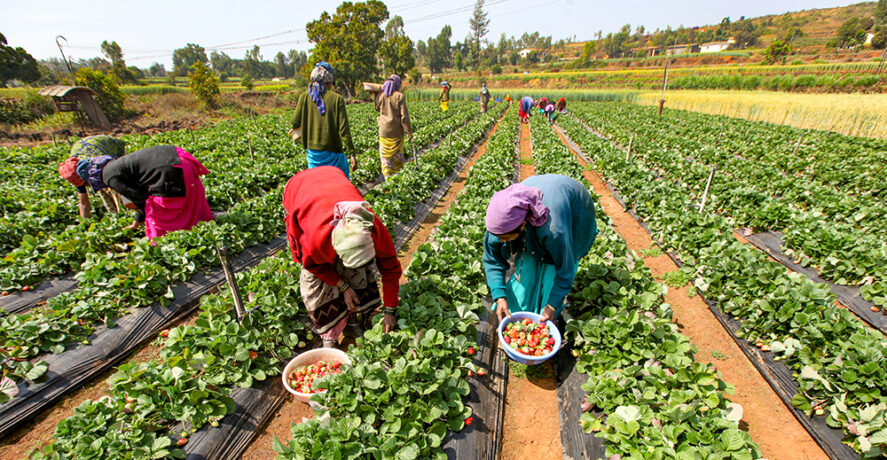
Featured image: A group of women farmers harvests strawberries. (Photo by Parikh Mahendra N/Shutterstock)